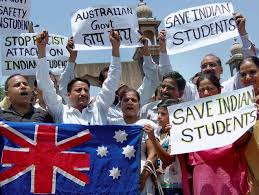
NSW should take adantage of Visa changes for overseas students and market itself aggressively.

Minister Chris Bowen [Minister for Immigration and Citizenship] and Senator Chris Evans [Minister for Tertiary Education, Skills, Jobs and Workplace Relations] have unveiled The Knight report and announced new changes in Visa rules for international students. These changes have been hailed by the key players in the International Education industry.

Bowen-Evans-Knight-Media-release

http://www.immi.gov.au/students/knight/

http://www.smh.com.au/national/postgraduate-education/overseas-students-get-easier-entry-working-visas-20110922-1kncv.html

http://www.theaustralian.com.au/higher-education/international-student-visa-changes-biased-towards-unis-tafe/story-e6frgcjx-1226144429513

http://www.couriermail.com.au/ipad/visa-change-to-help-foreign-students/story-fn6ck4a4-1226143636337

These changes are likely to lift the number of overseas students coming to Australia and will give a boost to the economy. This is a good news. International education is worth $18 billion nationally. Everything needs to be done to take it to a bigger level, while ensuring that the system is not rorted again. We do not want “Visa factories” again. These changes are likely to encourage genuine students, wishing to pursue education in Australia.

The main changes are;

  • Fast Visa approval process for bachelor or higher degree University courses
  • Less onerous criterion for financial support
  • Changes in the risk assessment criterion
  • 2-4 years guaranteed work Visa after finishing a bachelor degree or higher Uni courses
  • Australian International Education will be able to compete with UK, USA and Canada more effectively

The work visa is a master stroke. This allows people to work without any restrictions. I have no doubt that it will make Australia a very attractive place for International education.

Indeed, universities have been given some preference in the new system, largely because they are the places for higher and quality education. These changes will help TAFE too but unlikely to help the private institutions which had mushroomed previously, and many brought bad reputation to the industry and Australia due to poor quality education and exploitation of students. These fly by night operators and shonky providers had done enormous harm to this sector.

Quality control and monitoring of providers would be the key to keep Australia in the fore front. University sector gets about 25% of its budget from overseas students. This dependence on overseas students should not be allowed to dilute the standards of education in the universities.

These Visa rules will be reviewed periodically by the Education Visa Consultative Committee [EVCC] which will recommend changes as and when needed.

These are welcome changes and should help the growth of the industry. Michael Knight, Ex NSW Minister and the author of the report, has done a good job.

Finally, NSW Govt should do every thing to promote its universities to the overseas market, especially China and India, by removing the apprehension about safety issues, working towards some system for accommodation support in the beginning, and establishing a system which will deal with exploitation of students. The bogey of racism and racist attacks which some overseas media had reported without real basis can be tackled effectively. NSW delegation is visiting India in November. In addition to every thing else, it should obviously also have a focus on this sector. Nothing will assure Indian parents better if they hear from Indian Australians of high standing that Australia is a safe place to study, live and work. I believe that the $5 billion international education industry in NSW can easily grow to a higher level, if key players work smartly and effectively. Victoria is the number one destination for these students currently, but it could easily be NSW. After all, overseas students will come to NSW as a prefered destination, as it is a fantastic place with beautiful cities, beaches, renowned universities and multiculturalism in its DNA. This will happen definitely, provided NSW has been marketed smartly in the key markets.

Yadu Singh/Sydney/23rd September, 2011

www.facebook.com/dryadusingh

www.twitter.com/dryadusingh

Related articles

National organisation of Indian Australians is the need of the hour!

Australia has a substantial numbers of people of Indian heritage. It is approximately >250000. With students from India, this goes above >350000. It is going to increase as Indians have formed a good chunk of the total Australian immigrants over the last several years.

One of the things we have seen lately is the fact that there are Indian functions almost every weekend. In Sydney alone, we have had 6 Diwali functions including a big Diwali fair in Parramatta stadium. This Hindu Council of Australia fair was impressive and the biggest fair for/by Indian community. This is great.

With increased numbers, problems faced by some of us have also increased. It is expected. There are some issues however which appear to be more pertinent for our community. Students’ issues is one such example. There is a large number of ex-students who are in a bridging visa and are in fact in a limbo as the processing of their applications has not been progressing.

Negative portrayal of Australia by Indian media last year was often hysterical and imbalanced. This was not fair. Issues were there but the manner of coverage was not right. There were heaps of leaders issuing a variety of  views which were often conflicting. One leader had a habit of calling every incident as a racist incident without even waiting for full evidence. This type of reporting has a potential to create a backlash against Indian Australian community. I am not denying that there were serious issues in regards to Indian students and Indian media, in fact, helped bring them to fore-front but exaggerated and imbalanced coverage in many cases and overuse of  racism word was not helpful. A segment of Indian media literally branded Australia to be a racist country without bothering to check the basis or the facts for that claim.

With the issues created by some students ie documentary frauds, contract marriages and crimes committed by them, the reputation and image of Indian community has had a significant hit. This needs to be tackled too. We have to live and work here and our community can’t afford to have a negative image. Our image of a community of educated people with a relatively much less crime needs to be restored and enhanced.

There are several issues which our community must deal with. Helping new arrivals by mentoring is one of the things which we will need to do as a community. Helping new arrivals to integrate well is a very important mentoring job. Domestic violence and exploitation of our people, often by our own people, must be tackled.

There are issues between Australia and India. The classical one is about the sale of Australian Uranium to India which current Gov does not want to do. We obviously want to see that happen. Non-signatory status of India for NPT has no significance after India was given the India-specific NSG exemption last year with an active support from Australia. India also has a clean record on nuclear non-proliferation.

There are obviously several issues and I have mentioned only a few.

When educated Indian Australians with vision talk about the community issues, they do talk about the need for a national body which can take up the issues which have a national significance for the community. While doing so, they also talk about the mushrooming of “community leaders” every where, many of whom do not have an idea of conflict of interest. Many such “leaders” do not have the pre-requisite for the leadership role. Such national body must be able to work in a co-operative fashion with Indian/Australian Gov agencies including Indian consulates and the High Commission, and business-focused bodies such as AIBC.

We need genuine associations of Indian Australians which can tackle the problems of the community in a genuine way. These associations need to be pan-Indian in outlook and should not have a linguistic or regional outlook, focusing on the language spoken at home or the place of origin in India as the basis for the organisation.

We really have far too many associations and far too many “leaders”. Leaders of all associations must move on after serving for a maximum of two years. It is not a good idea for these “leaders” to use associations as a place for retirement activities. It is totally ridiculous to see “leaders” who are in their late 70s or 80s when they are clearly unable to grasp the situation and needs of our community. Respecting our seniors is one thing [and I too respect them] but that does not mean that we have to put up with their inefficient or inappropriate leadership. Issues of Year 2010 need leaders who can understand them and can do something about them. Our elder leaders [late 70s and 80s], if they have a burning desire to do community work, can do a great job by being the mentors and guides for the younger leaders. Their experience can be invaluable.

All such organisations must work in a transparent fashion. Indian ethnic media needs to do their genuine job to ensure that associations and leaders are doing the right job. Forming alliances with associations/leaders is not a good idea. This is a problem area.

We really need genuine leaders for our community and such leaders must be those who have;

  • vision and credibility
  • capacity to lead
  • ability to communicate with Gov authorities and people
  • ability to network and communicate with media
  • integrity
  • capacity to understand “conflict of interest” and practise it
  • capacity to follow the principles of transparency and accountability
  • capacity to lead by examples ie can be role models

Being “leaders” for photo ops and doing Melas [Fairs] only is not going to help! Taking commissions for their “leadership” is an absolute NO.

Some discussions are going on in these regards and an outcome is expected soon, hopefully.

One must not forget that we have literally hundreds if not thousands of “associations” most of which are essentially pocket associations of our “leaders”.  We can see how/why associations-based federation[association of association] at the national level will be a failure from the day one. It should therefore be an organisation based on individual membership, taken from the people who fulfill criterion explained above.

Dr Yadu Singh/Sydney/14th Nov, 2010

www.twitter.com/dryadusingh

www.facebook.com/dryadusingh

Australia-India relations and the issues of Indian students:IBN Live documentary [Hindi]

http://khabar.ibnlive.in.com/news/35809/2

Smita Sharma, a senior journalist from IBN Live channel was in Australia recently. She has made this comprehensive documentary. She did a good job and covered the issues of Indian students in Australia and sought the comments of Indian Australians who have been here for a long period. Ravi Bhatia of AIBC, Vasan Srinivasan of FIAV, Anupam Sharma and myself were interviewed for this documentary. She managed to speak with some actors from a Bollywood movie  on this topic [a Mahesh Bhatt movie which was being shot in Australia at that time] too with the help from Anupam Sharma.

It is in HINDI. It is in multiple segments.

It is a very balanced documentary. It is definitely worth a watch.

Yadu Singh/Sydney/13rd July, 2009

A Blog & a brilliant editorial on Visa Capping Bill 2010:a must read!

Yadu Singh dryadusingh

http://tinyurl.com/2b8zvkz Visa capping bill 2010 is a disgrace-says this Blog.

I am enclosing an editorial  by Pawan Luthra, Editor, Indian Link newspaper. He has written a very pertinent and a brilliant piece on this matter. Thank you, Pawan.

————————————————————————————————–

“The Visa capping issue

… is becoming the international students’ worst nightmare, says PAWAN LUTHRA

Minister Chris Evans could have the power to effectively order potential migration applications to be declared null and void if the Migration Amendment (Visa Capping) Bill is passed. This means that applicants will not be given a chance to appeal this decision and will have to leave the country within 28 days. With the Coalition remaining quiet on this and a minimal fuss from the Greens, chances of this becoming law are strong. Those most affected are potential migrants, a number of whom are students who may have studied in Australia for over two years. They have contributed thousands of dollars to the Australian economy, been model guests in this country and, in the future, could do Australia proud.

But now they’re becoming victims this game of politics masterminded by the Labor government which has been caught flat footed from the events in the student community since the past year. It is a transparent tactic of the Labor government, seeking to deflect focus from its refugee policies. It is easier to lay blame for the expansion of the student and migration market on the Howard government, rather than work to capture this special resource of talent already existing in the country. Caught within this political crossfire are the hopes and aspirations of thousands who have been waiting for over two years to have their visa applications processed and who now may have jobs, partners, children and other assets. They may have to abandon all this, as the possibility of being thrown out of the country within 28 days of Minister Evans decision imminently looms.

The Migration Amendment (Visa Capping) Bill 2010 would enable the minister to cap the number of visas issued in a given year to applicants with “specified characteristics.” This could include chefs or hairdressers or any other occupation. Once the designated annual cap is reached – which could conceivably be set at zero – all outstanding visa applications with the same characteristics will be terminated. So its wasted dollars for someone who has spent thousands in getting their health checks, skills assessed and qualifications recognised. Yes, the visa application fee will be refunded, but all other costs will be borne by the applicant. This does not include the cost of education which the applicant may have embarked upon in Australia with a dream of applying for residence based on the general intent of the laws at that time.

What the Labor government is doing isn’t wrong, but the sentiment is indeed immoral.

As depicted in the famous Australian movie, The Castle, Daryl Kerrigan fought a property development company which wanted to acquire his house to extend the airport. In the climax, the barrister representing Kerrigan said that it was not a house which the property developer was acquiring; it was a home of dreams and memories. Similarly, a migration application can be terminated abruptly and without notice, but it is at the priceless cost of destroying the dreams and ambitions of thousands of potential migrants. It is a heartrending sight and their despair is palpable.

Now is the time for community leaders to speak up and fight for the rights of these students. Public statements and petitions have been made by well intentioned individuals; but it is time that our Indian associations take this cause forward, in a test of true and vocal leadership. Visa capping in its current form is wrong and this message needs to be sent, loud and clear, to Canberra and the Rudd government.”

Editorial by Pawan Luthra

————————————————————————————————————————-

Similarly, Anuj Kulshrestha, Editor, Hindi Gaurav, has written a great piece on this matter. He has included comments from some of the leaders from “Friends of International students” with his write-up. Thank you, Anuj.

http://www.hindigaurav.com/community-news-0-65

————————————————————————————————-

Indian Sub-Continent Times [ http://www.theistimes.com/mr-evans-its-democracy-not-anarchy/ ] has written a great article on this issue too. Thank you, Ashok Kumar.

————————————————————————————————

Please click www.fairgo4internationalstudents.org/ and support the petition against this Bill.

“United we win, divided we lose”.

Regards

Yadu Singh/Sydney/28th June, 2010

http://www.twitter.com/dryadusingh

“Fair go” for international students:an appeal from the Indian Australian community.

Hello

A large number of leaders from Indian Australian community met in the Harris Park community centre earlier this month. Several international students were there too.

UIA, GOPIO, FAIA, Australian Punjabi Heritage Association, AISA, Australian Punjabi Business Association, Punjabi Council, Malayali Association, Tamil Manram, TAA, Hindi Samaaj, Deepavali Committee of NSW and others were represented. Many other associations have extended their support too.

Harry Singh, Raj Datta, Moninder Singh, Rohitas Batta, Padmanabham Karamil, Navjot Singh, Ajay Sharma, Ranjit Khera, Prabjot Sandhu, John Niven, Amarinder Bajwa, Lucky Singh, Harry Walia, Vish Vishwanathan and many more were there. I joined it too. Several student leaders like Raveena Garg, Apoorv Chaturvedi and Syed Sakib were there to share their situation.

From this meeting, a group called “Friends of International students” comprising of 10 people was constituted. Its membership is listed in the website which is enclosed.

http://fairgo4internationalstudents.org/

There is a concern among people in regards to the potential for unfair outcomes for the former international students, if the Visa capping bill 2010 becomes an Act. This Bill, if it becomes an Act, will give powers to the Immigration minister to apply “cap and terminate” provisions of this Act retrospectively.

As another post in my Blog [ http://tinyurl.com/2ftcspt ] explains, this Bill has some features which may have very serious implications for former international students who have completed their training/education in Australia, have applied for the PR and are on bridging Visa currently. No body has any argument about the prospective application of the powers of the Act [if this Bill is passed] but people are very concerned about the potential use of the “capping and cull” powers retrospectively.

BTW, others also have concerns in these matters. Some links are enclosed.

http://tinyurl.com/2exu5cd
http://tinyurl.com/265hxht

My appeal to you is;

-to visit the Website http://fairgo4internationalstudents.org/

-to consider supporting the petition in support of these ex-students[who have been here for years, finished their training, have applied for PR and are on bridging Visa.

-and to forward the links to your friends and contacts for their support.

Regards

Yadu Singh/Sydney/26th June, 2010

http://www.twitter.com/dryadusingh

SBS Radio [Hindi]:my interview on Visa capping bill 2010.

http://www.sbs.com.au/yourlanguage/hindi/player/page/day/Sunday/time/09/channel/3

It starts at 35.15 and goes until 45.oo minutes.

Ms Kumud Merani was the interviewer.

This covers the Australian Migration Amendment [Visa capping] Bill 2010. Some people have called this Bill as “cap and cull” Bill.

Please see a detailed post on this Bill in my Blog.

Yadu Singh, Sydney/13th June, 2010

Migration amendment [Visa capping Bill] 2010:what is it all about?

Australian Migration Amendment [Visa Capping Bill] 2010 has been through the Lower House of Australian Parliament last month. It is currently with a committee of the Senate. People have been asked to send their submissions. I understand that people can still send their submissions.

Visa Capping Bill has caused severe anxiety among the International students as it has certain features which may have some serious impact on their chances to be Permanent Residents in Australia. Their anxieties are outlined very clearly in their comments to the National Interest programme of ABC Radio National, anchored by Peter Mares who interviewed Minister Evans. Mark Webster who is an expert in this area and is the chair of Migration Institute of Australia, NSW chapter and Peter Mares had also written summaries on this matter.

Here are the links of this Radio National programme and other relevant write ups.

http://www.abc.net.au/rn/nationalinterest/stories/2010/2918752.htm

http://inside.org.au/capping-and-culling-the-migration-queue/

http://www.theaustralian.com.au/news/nation/death-knell-for-overseas-students/story-e6frg6nf-1225878156303?from=public_rss

http://www.acacia-au.com/general_skilled_migration_changes_8_feb_2010.php

http://www.acacia-au.com/GSM_changes_impact_on_international_students.php

http://www.acacia-au.com/frequently_asked_migration_questions_student_forum.php

http://www.acacia-au.com/Minister_Seeks_Power_to_Terminate_Visa_Applications.php

http://www.acacia-au.com/comments_on_chris_evans_immigration_capping_bill.php

I enclose the link from Dept of Immigration website on this matter too.

http://www.immi.gov.au/skilled/migration-amendment.htm

As we recall, Minister Evans has been saying that Australia wants to have a demand-driven Immigration programme, not a supply driven programme. He has mentioned that we have an oversupply of cooks and hair-dressers. Instead of them, we need doctors, nurses, engineers etc.

To achieve this result, he has done several things. One was to bring out this new Skilled Occupations List [SOL]. Others included putting a temporary freeze on granting Visa from the beginning of May 2010.

Visa Capping Bill is the latest instrument which Minister wants to have it passed by the Parliament. This will give him the power to manage the Skills categories and the types of migrants which are needed in Australia. With this power, Minister can outline “characteristics” of the applicants and apply a cap on the number of Visa given to that category  in a particular year. After that number has reached, all remaining applications are “terminated” as if they have never been made. “Termination” is different from “rejection” because “terminated” applicants will not have a right to challenge that “termination”. The application fees for such applications will be returned but it will not include fees one has paid for migration advice, medicals and other associated expenses.

About 61000 places are available for the General Skilled Migration [GSM] places for the next year. There are already 147000 applicants for GSM in the queue right now and more than 25% of them [38990] are from International students who have completed their studies in Australia. 17594 are cooks and hair-dressers alone. Quite a lot are on bridging Visa, awaiting the final decisions from the Immigration dept. Let me give an example to clarify things here. If Minister Evans picks the characteristic “Cooks” and applies a “Cap” of a certain number [likely to be a small number], then all remaining applicants from “Cooks” category will be “terminated” even though these applicants have been on the waiting list for decisions for years. These “terminated” applicants will have 28 days to leave Australia. This is where the anxiety is coming from.

If you see the comments in the Radio National programme and the submissions to the Senate committee, people have been in Australia for many years. They have sacrificed a lot. They had to arrange huge amounts of finances by taking loans, selling/mortgaging their houses/farms before they came to Australia on a student Visa. Australia allowed them to come and study here. Australian International education was marketed [marketed by those who were involved in marketing on behalf of International education in Australia] with the lure of PR visa because certain courses/trades were in the preferred list which would give them the almost certain chance of getting a PR Visa after completion of their diploma/course/training. Australia was a preferred place for international students because of this link. It is true that Australian Gov itself did not declare this link in a legal sense but this link was clearly used in the marketing. There was a practical link of getting PR after completion of certain courses because those courses were in the preferred list. By the way, it is not a serious argument today that previous Gov was wrong in linking education with immigration. This argument is not going to help the issue at hand.  There is no denying that mismanagement has taken place. Many are now of the opinion that education and immigration should have never been linked.

New SOL has removed many of the low value courses which is a good thing. This will take care of future students. Visa capping bill gives powers to the minister to manage the waiting list of those whose trades are not in demand anymore and are not in the new SOL but whose applications are pending for PR at this point of time. Apparently, there is a massive backlog of >2 years for general skills migration [GSM] applications. Backlog is one thing but Minister also wants to make sure that people with low-value trades are not getting PR and distorting the overall mix of skills which Australia gets from GSM.

Australia has the sovereign power to decide who it will accept as immigrants and what skills it needs. Nobody can have an issue with this inalienable power.

As is true with every power, the powers of this nature should be used judiciously [and Minister admits it himself], keeping in mind the “human consequences” of those who will be affected. Powers of this nature should be used keeping in mind that “these” people came here because Australia allowed them through a smart [or was it?] marketing and they have invested huge amount of money and time in Australia over 4-5 years. We have to be mindful that many of the students and their families back in whichever country they came from will have very difficult times if their “investment” of money and time fails and they are forced to leave Australia in this manner.

If you read the comments as mentioned above, many Ex students are already in the relevant jobs after completing their training. There is no reason why they can’t get the PR. They will suffer too if the power from this Bill is used as they will be in that “characteristic” or “cap & cull” category.

Yes, people can go for PR via Employer Nomination Scheme [ENS] or get PR via State or regional sponsorship scheme  if they can get such sponsorships [SOL does not matter for such sponsorships] but it is not going to be available for most.

The discussion on a topic like this will always bring the question of whether the changes should be prospectively applied or whether it is fair to apply them retrospectively.

Minister Evans has sought this power but has not declared which trades he is definitely going to target. Cooks and hair-dressers have however been mentioned repeatedly. Which “class or classes” will be subjected is not clear but this can be applied to any “class” as there is nothing in the Bill which excludes any “class” on which this “cap and cull” power can not be used. Protection visa is the only exception.

Minister Evans has his justifications for this power but I am concerned about the “human” consequences and with the plight of students. I am visualising very serious difficulties for affected international students and their families with possible impact on their physical and mental health.

When new SOL was declared, I thought the transitional measures were going to be useful for those who were impacted. With Visa capping Bill, it appears that the relief offered by transitional measures may be taken away for at least some trades like cooks and hair-dressers.

What is your view?

Dr Yadu Singh/Sydney/June 11, 2010

http://www.twitter.com/dryadusingh

OZ’s new Skilled Occupations list [SOL]:Frequently asked questions [FAQs].

http://www.immi.gov.au/skilled/general-skilled-migration/pdf/faq-new-sol.pdf

Here are the FAQs and their answers on the new SOL from the Dept of Immigration and Citizenship website.

Please refer to the link for all the info or call dept of Immigration & citizenship on 1300 735 683

Yadu Singh/Sydney/31st May, 2010

http://www.twitter.com/dryadusingh

Australia’s new Skilled Occupations list [SOL] for immigration:Changes which were overdue!

Senator Chris Evans, Minister of Immigration of Australia has announced the new Skilled Occupations list [SOL] today.

It has excluded cookery, hair-dressing, community welfare and other low value trades/skills from this list but it does have doctors, Engineers, nurses, teachers, construction workers, IT professionals and accountants among others. I liked this list and support it fully. I spoke on this matter today and here are the links.

http://www.abc.net.au/worldtoday/content/2010/s2901431.htm

http://player.sbs.com.au/naca/#/naca/wna/Latest/playlist/Skilled-migrant-list-to-shrink/

http://www.immi.gov.au/skilled/general-skilled-migration/pdf/new-list-of-occupations.pdf

As we all know, Australia’s international education is [or at least, it has been until recently] a significant source of income ie about $15 Billion/year and has been quoted to be the third biggest source of the economy. It has grown dramatically over the last few years. Chinese and Indian students were the backbone of this growth. This growth was more true for the private vocational sector as compared to the University/TAFE sector. It was estimated that about 80-85% of Indian students came to Australia to study in the private sector, most commonly in cookery related courses, hairdressing and community welfare. To cater to the increasing demands, a lot of private schools were opened by entrepreneurs, many of them did not provide proper and good quality of education. Exploitation of students was rampant and unfortunately, the quality control mechanisms were not as active as they should have been. When the problems in this sector were brought out in the open by Indian and Australian media and quality issues were taken up with seriousness by Australian agencies as a result, many of these private schools started to close down, leading to more difficulties to the students.

With the assaults on Indian students and hysterical and often exaggerated reporting by Indian media which damaged Australia’s reputation, Australian agencies finally decided to take the remedial actions to clean this sector. Multiple task forces were set-up and serious reviews were done. It became quite clear that Australia’s international education system has been rorted by many students, some migration agents and some education agents. Some students came to Australia with no interests to study. Even human smuggling has been mentioned as a way to send some so-called students to Australia. Some of these students had poor English, educational and financial backgrounds. False certificates of all sorts and even contract marriages were employed to bring the so-called spouses in many cases.

Many of these students were applying for the PR visa even though they did not have the requisite qualifications to be able to find the employment. They were able to get the PR only because their trades of cookery and hair-dressing were in the preferred list for immigration.There was a serious question of the suitability of these people to become immigrants of this country.

Finally, something has to be done and new skills list is the outcome.

Skills Australia-an independent body has helped bring this list out. This list will be updated annually.

Senator Evans has outlined that Australia’s immigration programme will be demand-driven, not supply-driven. He said that Australia needs teachers, doctors, nurses and IT professionals, not cooks and hair-dressers. He also said that Australia’s immigration programme can not be controlled or driven by international education only. Senator Evans is spot on here.

These changes were overdue but as people say, it is still better late than never.

Australia should attract and encourage the right type of immigrants with qualifications which we need.

International education and PR should not be linked. It was never linked in a legal sense but an expectation of this “link” was created by the marketing agents. It was known to every one including Australian agencies that PR lure was responsible for the spectacular growth of students numbers from India and China. Having said that, these students came to Australia because Australia allowed them.

While I support this new skills list whole-heartedly, I am concerned about the plight of those students who are already here. They and their parents have invested a lot of money-often mortgaged their homes and farms to send them to Australia. They came here with the expectation of PR and this was not totally their mistake. They came here under previous rules and had valid reasons to hold an expectation for PR Visa after completing the diploma.

The current and changed situation has shattered their hopes. This is akin to a humanitarian tragedy for them and their families. It is going to have a very serious ramification for some of them.

I do believe that some significantly fair transitional steps should be taken to consider their situation, provided they meet the English, training and work experience standards. I am generally against retrospective rules and their case is a classical example where it should not be implemented retrospectively.

Is there a case for a fairer transitional steps/strategies in these matters?

While I congratulate Senator Evans for this new Skills list, my view is also in favour of fairer transitional steps in this matter and I believe that there is a very strong case for this approach!

Dr Yadu Singh/Sydney/17th May, 2010

http://www.twitter.com/dryadusingh

False allegation of racist torching in Melbourne:Jaspreet Singh pleaded guilty and got 8 months suspended jail sentence.

http://tinyurl.com/2f45e3l

Jaspreet Singh who burnt his own car with the intention of making a false insurance claim has been given 8 months suspended prison term. This is the guy who claimed that some people tried to burn him in Melbourne in Jan, 2010. He himself received burn injuries to 30% of his body in the process. You might remember that Indian media reported this incident prominently, calling this a racist attack and branding Australia a racist nation.

He has now pleaded guilty in the court due to which he has received a suspended jail sentence.

Many think that he has got a reasonably lenient punishment.

What about the harm which the false allegation of a racist attack caused to the image of Australia? Who is paying for that?

With this case, it is very clear that it is a bad idea to jump to conclusions without full facts.

Question to him and to Indian media: will they apologise to Australia now for the false allegation and reports?

I believe that they should offer a public apology to Australia and Australian people which include us [Indian Australians] too.

Yadu Singh/Sydney/3rd May, 2010

Indian students in Australia: This Times of India article is spot on!!

Indian students in Australia

——————————————————–

http://timesofindia.indiatimes.com/home/sunday-toi/special-report/Oz-us-A-banged-up-equation/articleshow/5826770.cms

Clarification: Gautam Gupta, mentioned in this article, is an Audiologist, not a cardiologist.

Oz & us: A banged-up equation?

Dileep Padgaonkar, TNN, Apr 18, 2010, 01.39am IST

Article

MELBOURNE: An evening of merrymaking that ended in a nightmarish experience in May last year gave Shravan Kumar his 15 minutes of fame. The young Andhraite, a student in a private college here, had hosted a party at his home in a western suburb of the city to celebrate his birthday. All the 20-odd guests were fellow Indians; all pursued vocational courses in institutions of dubious worth; all led a hand-to-mouth existence; all worked well beyond the stipulated 20 hours a week; all settled for wages much lower than the official wage; all lived four-to-six in a room; and all were fired by a single ambition: to acquire permanent resident (PR) status within two years of their arrival in Australia.

Liquor, much like loud music and laughter, flowed freely at the party. On such occasions, it is not unusual for uninvited guests to join in the revelry. When two young, white gatecrashers rang the doorbell, the Indians welcomed them with open arms. But soon the booze began to take its toll. Hot words were exchanged when the whites made passes at Indian girls. They were shown the door.

Minutes later the boys turned up again. Unknown to the Indians, one of them carried a screwdriver in the pocket of his trousers. They were allowed to come inside in the hope that they would behave themselves. But no sooner had they stepped in that the boy with the screwdriver plunged its sharp edge into Shravan Kumar’s skull. This is when all hell broke loose.

Even as Shravan Kumar struggled for his life in the hospital, a small group of left-wing radicals, both Indian and Australian, staged a demonstration outside the Victoria state Parliament House. They shouted angry slogans, pelted a few stones and bricks, broke some windows. From the sidelines, half a dozen or so members of the Australian Socialist Party, a fringe group, made provocative speeches. Among the rabble-rousers, according to a witness, was an Indian, Gautam Gupta, a failed businessman and a jobless cardiologist who over the years had fancied himself as an avatar of Mahatma Gandhi and Nelson Mandela. (Efforts to reach Gupta bore no fruit.) By sunset, the police had dispersed the demonstrators. Along the way however they, and especially the firebrand Gupta, attracted a huge amount of attention in the national media. And that coverage in turn got the Indian media all worked up.

On certain TV news channels in particular, charges of racism flew thick and fast. Fuelling their rage was the initial claim of the Australian authorities that race did not figure at all in the attacks. No one this writer spoke to, including office-bearers of the Federation of Indian Associations of Victoria, denied that racial prejudice had to be taken into account to understand the factors that led to the tragic sequence of events. At the same time they emphasized that such prejudice was limited to a small group of young ruffians. To focus solely on race, as the Indian media had done, detracted attention from the more important factors that caused the crisis in the first place.

The most significant factor by far was the decision taken by the previous John Howard government to open up the vocational education sector to private groups and link it with migration. This was the government’s logic: invite young people to study in the country in order to boost earnings from education; persuade them to develop vocational skills needed to grease the wheels of the economy; give them permission to do part-time work even while they took their courses; above all, dangle before them the carrot of PR status two years after their arrival, provided they acquired a certain number of points in their studies.

The policy was disastrous on many counts. Individuals with no experience in the educational field, including a shop assistant from Kerala, were allowed to open colleges. The government did not bother to find out how they functioned. There were no controls — on the kind of courses offered, fees charged, the number of students admitted. For instance, permission had been given to enrol, say, 250 students. Double the number were enrolled. In no time, more than 170 private colleges mushroomed in Victoria. As many as 40% of them were controlled by individuals from the sub-continent. More often than not, their backers were former Australian politicians. They constituted a powerful lobby that no government could go against.

Between 2006 and 2009, the annual number of Indian students admitted to private colleges was more than three times the 2005 figure. This was the handiwork of Indian agents — nearly 1,700 at the last count — whose job was to lure prospective applicants with tall promises. In return for an investment of Rs 12-15 lakh, the student was assured ‘help’ to procure a visa (including a certificate certifying good knowledge of English), admission to a ‘posh’ college, a well-paid job on arrival, good accommodation, a great lifestyle and, not least, PR status after two years. Most of the agents’ ‘victims’ came from three states — Andhra Pradesh, Gujarat and, above all, Punjab. The agent’s commission ran-ged between 15-20% of the overall expenditure.

Aiding, if not quite abetting, the agent was Australia’s lax visa regime. The visa-seeker had to furnish proof that he had enough money in the bank to pay for the travel, tuition fees and lodging and boarding costs for two years. With the agent’s help, a loan would be obtained from a bank by the applicant or his family, the money deposited in an account for three months and the bank statement attached to the visa application form. As soon as the visa was granted — without a counter-check or an interview — the loan was returned to the bank and the student was left high and dry.

This is where his travails began. There was no one to receive him at the airport. He had to make his own arrangements for accommodation. The ‘posh’ college was often a small, decrepit structure. Courses were few and far between. They were of course conducted in English, a language the student barely knew. To sustain himself, he worked long hours at all sorts of odd jobs and accepted wages well below the official rate, which placed him at odds with local job-seekers.

The illegal wage was paid in cash, which the student carried on his person. That made him a target for attack, especially when he took the last train home located in a remote suburb. In case he was assaulted, he never turned to the police for help because that would mean exposing the illegality of his working hours and wages. With no family support system, no contact with Indian associations or the Indian consulate, no friends in any other community, he had no choice but to seek the company of similarly placed fellow Indians. In the few hours he had for rest and leisure he would drink himself silly, sometimes take to drugs and gambling, enjoy loud music and, not least, chase girls. None of this obviously endeared him to the host population.

For Indian girls, the experience has proved to be far more harrowing. According to Krishna Arora, a community leader, Punjabi girls have been the worst victims of this search for an El Dorado. An educated girl is married off to a rich farmer’s son. In return, the father-in-law agrees to fund her travel, tuition and stay in Australia. Her husband, who is entitled to get a spouse visa, goes along with her. Once they land, the husband links up with other women, treats his wife shabbily and as soon as both get their PR, he files for divorce, obtains it and goes his own way leaving the young woman to fend for herself.

Last year, of the 18 cases of domestic violence reported to the Melbourne police, as many as 13 were student-related. Victims of such violence do receive some financial assistance from the government. But the money is grossly insufficient. As a consequence, more and more such women take to prostitution. Indian women make up a sizeable percentage of the escort service business in cities across Australia.

Indian community associations are making a valiant effort to come to the rescue of students duped into coming to the country. They are lobbying the government to strengthen security for Indians and to come down hard on the perpetrators of violence. The Indian consulate, too, is straining every nerve to assist them. But it is woefully understaffed. All the same, the leaders — including high-profile ones like Vasan Srinivasan, who very nearly got elected to the Victoria parliament; Vernon da Gama, a hugely sought-after solicitor and Ravi Bhatia, the suave and highly admired CEO of a telecom company — are unanimous in their belief that the issue at stake in the spate of attacks on Indians is not so much racism as a question of maintaining order and enforcing the law.

They repeat that the Indian media’s charges of racism quite correctly rile the Australians. This, in turn, tarnishes the entire Indian diaspora, most of whose members are successful professionals and adds strains and stresses to the India-Australia bilateral relationship. I asked the community leaders why Indians were targeted and not students from other countries. One reason, I was told, is that most of the other students come from good social backgrounds. They have a working knowledge of English and have the necessary funds to pay for their education.

Indeed, most of them study in universities, not in private colleges. Their numbers are small. As against this, the sheer size of the Indian student body, its general rowdiness, pecuniary situation and inability or unwillingness to live according to local norms gives it a higher visibility and makes it a target of suspicion, prejudice and sometimes violence.

Australia, one Indian executive told me, can be a tough place to live if you don’t know English, don’t know how to use a Western-style toilet, don’t know elementary rules of courtesy, if you don’t follow traffic rules and are perceived to be a lout. That, he said, was the case with most Indian students. And a bulk of them come from Punjab — indeed, straight from a Punjabi village to a cosmopolitan metropolis like Melbourne or Sydney. In no position to handle the culture shock, they just go out of control.

The attacks on Indians have, however, had a negative impact on Australia’s booming education business. Figures published by the Federal Education Department just days ago show an overall decline of foreign students seeking admission to the country’s colleges and universities. The decline is sharpest among Indian students. Numbers plummeted 40% in Victoria, from 6,303 to 3,761 for the first two months of the year. Especially affected are private vocational colleges. Experts believe that the numbers are likely to drop further in the months ahead.

The Australian authorities have finally begun to take meaningful steps to arrest the trend. Regulations for private colleges have been toughened; 21 rogue institutions have been identified. Rules have been changed to grant licenses to educational entrepreneurs. They are now obliged to re-register to meet the standards prescribed in the National Education Code. Some 1,500 educational providers have to undergo stringent tests. And courses like hair-dressing have been scrapped.

Visa regulations, too, have been revised. Now money needed for travel, tuition and boarding and lodging has to be deposited in a bank for six months instead of three. The Australian High Commission has been asked directly to consult chartered accountants and banks to verify the bonafides of the visa applicants. Living expenses have been raised from AU$1,000 to AU$1,500 a month. English proficiency tests have been made more rigorous. Most important of all, rules to grant permanent resident status have been overhauled to make it that much more difficult to immigrate.

Indian community leaders now hope that the Indian authorities will also crack down on unscrupulous agents and make sure that students wanting to study in Australia are given an accurate picture of the conditions that await them on arrival. Similarly, they would like on-the-spot reporting by Indian journalists of the problems confronting Indian students. This, they say, is urgent because under the revised rules, visas of a substantial number of students are not likely to be extended once they expire. This could well lead to more protests and perhaps to an outbreak of violence just in case a desperate student, unwilling to return to an uncertain future back home and fearful of losing face, attempts to commit suicide.

Meanwhile, Shravan Kumar has staged a remarkable recovery. The Australian government paid his hospital bills as he had no health insurance. It also funded the visit and stay of his father, brother and uncle. Undeterred by charges of racism and fears for his security, the young Andhraite applied for permanent resident status. He obtained it days ago. He is not quite sure if he will return to India once he finishes his courses. But chances are that he will choose to remain in Australia to get on with his life, hoping that by and by he will put behind him the birthday bash that turned into a ghoulish nightmare one balmy day in May last year.

Readers’ opinions (31)

Prerak Garg Kharagpur 18/04/2010 at 09:34 pm

A very nice and balanced point of view. Kudos to TOI for bringing out the true story.

Rohan Handa Melbourne, Australia 18/04/2010 at 08:31 pm

I am a student at Swinburne university, Melbourne and have been reading almost all the articles been written on this topic by various authors. This article, by far, is the most accurate and comprehensive account of whats really going on here. I would like to thank the author for his efforts.

reena India 18/04/2010 at 07:52 pm

It appears that you are one of the Indian journalists hired by the Australian government, whose entire living and travel expenses were paid, in order to project Australia’s image as a fair country, in the eyes of the International community! Are you one of those journalists, Mr. Dileep Padgaonkar??

Sunil Adelaide, Australia 18/04/2010 at 07:51 pm

Finally a well-researched honest article… If only every Indian was this sane….As an Indian living in Australia this is exactly how it was then, is now at present and will be in the future. A big clean-up act from both Indian and Australian authorities is the only way to right the wrong.

UMAKANT Melbourne 18/04/2010 at 07:10 pm

Good and TRUE article… it is a real scenario put in by this TOI article. I too agree with all things put in by Duleep. Most of the things happening against the Indian community is because of the raw and ripe behavior of their very own Country (PENDU or DESI) men.

Community work:what I have done so far.

Updated on 11th April, 2011.

Information

Here is my account about what I have done so far and what I am doing right now.

1. Community work in General:

1.1. Leadership roles in Indian community Medical Associations, Continuing Medical education and Health education of general community.

1.2. Helping poor people from our community ie visitors, overseas patients and Indian students when they are in need of health care in Australia without sufficient financial resources.

1.3. Helping poor students in my district with  scholarships etc.

2. My work as the co-ordinator of the Indian Consul General’s committee on students’ issues:
Indian Consul General’s Community Committee on Students’ Issues, Sydney, NSW was formed at the Indian Consulate on 6th April 2009. It did intensive work and completed its task in a very efficient manner. After accomplishing its mandated task, it dissolved itself at the end of June 2009 and communicated this to the Indian Consulate on 1/7/09.

The committee had Harmohan Walia,Vish Viswanathan, Shubha Kumar, Stanley D’Cruz and Dr Yadu Singh as its members. I was its co-ordinator.

This committee had done following activities;

#met students numerous times.

#organised a students’ forum on 16th May at Strathfield.

#co-organised a students’ forum with UIA in Strathfield on 6th June.

#arranged help to a woman student who was a victim of domestic violence.

#arranged help to 2 women students who were stalked by another Indian co-worker.

#arranged meetings with minister of education, NSW and her senior advisers and students from an aviation school-Work in progress.

#arranged a meeting with the president, NSW upper House [Mr Peter Primrose] and Ms Helen Westwood MLA and students.

#arranged meeting of an aviation school student with consul General [this student gave him his papers].

#arranged a meeting with a community minded lawyer and aviation school students.

#met the mother of a student of an aviation school. This lady’s husband had died only 4 weeks ago due to the serious stress involved in losing the money with the school in Sydney without the required outcome.

#arranged and participated in TV coverage of students’ issues on Channel 7, 9, 10, SBS TV, ABC TV, and Bloomberg.

#participated in the coverage on ABC radio, SBS radio, SBS Hindi radio, 2UE, JJJ, Indian Link radio, Radio UMANG, 2GB radio and SBS Kannada Radio.

#arranged talk-backs on these issues on SBS radio and Radio UMANG [98.5MHZ, Fridays,8-9 PM]-now stopped.

#participated in coverage on SMH, The Australian, Daily Telegraph, other newspapers and AAP.

#participated in the coverage on Indian newspapers in Australia [The Indian, Indian Link, Indus Age, The Indian Sub Continent Times, Indian Down Under].

#participated in TimesNow, NDTV, CNN/IBN, Headlines Today, AajTak and other Indian TV Channels.

#participated in the coverage on main Indian newspapers and PTI.

#involved with some top-grade Australian media programmes with wide audience in getting students’ issues covered.

#arranged funds for the accommodation for the relatives Mr Rajesh Kumar [the petrol bomb victim from Harris Park] within 24 hours.

#met commander Robert Redfern , Parramatta Local area Command of NSW Police several times.

#did what we could do to persuade/help the students when they were on the Harris Park streets for 3 nights.

#participated in the community leaders’ meeting with chairman, Community Relations Commission [CRC] at CRC HQ

#participated in a CRC organised meeting with Indian students at Parramatta RSL.

#participated in the community leaders’ meeting with the Premier, Mr Nathan Rees

#Met Indian Consul General and Consul several times

#helped a prominent Indian TV channel with a documentary on true situation in Australia. One of us [Yadu Singh] was the citizen Journalist.

#discussed and formulated the strategy to solve the problems of our students.

#submitted our strategy to the NSW task force and other relevant authorities.

#provided leadership in the matters relating to Indian students.

#gave our after hours and week-ends for students’ work and provided pastoral care to the needy students.

#provided/facilitated medical help to the needy students/their family members.

#met the visiting Indian journalists at the Consulate.
The committee members were all hard-working people with top-grade integrity. They did not have any conflict of interest in the matters relating to Indian students. None of them were involved in the students’ placement in a school [after taking a commission], running of any such school or running of any business which could have a potential conflict of interest in any manner.

All members worked with full dedication, cohesion and team feeling without any undermining of one another. This itself is a rare thing for an Indian group. We are proud of our work and ourselves.

We appealed to every person from Indian background to stay away from any leadership role if they were involved in any activity which did/could create a conflict of interest in these matters but we did not succeed in this matter.

We raised our voice forcefully against the exploitation of Indian students by some Indian employers.

We also appealed to the Indian newspapers and Radio programmes to ask questions from every leader [on students’ issues] about their involvement in any activity which  created a conflict of interest in those matters. We suggested that the  media should start with the questions on conflict of interests when interviewing those leaders.

3.My work beyond/outside the Consul General’s committee on students:

a. helped the refund of >$12000 to a student of a Flying school.

b. arranged legal assistance to the students from this Flying school from a solicitor in Sydney and Canberra.

c.1. facilitated a good outcome between parties involving VETAB, Flying school and students.

c.2. held several meetings involving VETAB high authorities, the Flying school and students in VETAB and my offices.

d. organised further refunds/savings [including waiving of about $50000f the legal fees in regards to a legal proceedings in the Supreme Court where students had lost their case and costs was awarded against them]] for a Flying school students from ESOS scheme with the help of VETAB, DEEWR and federal education dept which is worth >$250000 . I was the key and the only Indian person in this work for these students. I did this as I felt it was my duty to help students from my community who were feeling powerless in Australian system.

e. held meetings involving a Flying school people, VETAB and students.

f. helped payment of >$2400 to a student which was originally denied by his employer.

g. arranged funding of about $1000 to the family members of the “Petrol bomb” victim.

h. donated $500 to a students association.

i. arranged sponsorship for foods, meeting hall and public liability insurance for a students’ association [worth >$1000].

j. mentoring students for their careers and future in OZ.

k.1. donated $500 to AHIA’s seniors.

k.2. donated $500 to Fiji floods relief fund via International congress of Fiji Indians and organized $2000 donations from other doctors

k.3. donated $500 to Sanatan Arya Pratinidhi Samaj, Sydney.

l. donated a good amount [>$2000] for needy/deserving causes involving victims of earthquakes, accidental deaths, injuries and illnesses.

m.1. helping several students including assault victims for their work comp, treatment and issues involving their parents.

m.2. Liaised with NSW Police high ups in regards to the assaults of 2 Indians in Sydney.

m.3. Advised/mentored several others in regards to the steps they needed to take when they were assaulted.

n. established a benevolent fund for the community with further activities in the process.

o. participated as an active member of the working party with CRC on students including inputs for Z card.

p.1. took leadership role via the media including Indian and Australia media [Chanel 9, SBS, NDTV, Indian ethnic newspapers].

p.2. helped Radio National in making a documentary on students [see details in this BLOG elsewhere].

q. raised the issue of OZ Uranium sale to India during the Australia India Day celebration on 24th Jan, 2010 where several ministers, MPs, MLAs, MLC, and media people were present.

r. helped community members’ relatives/parents including FIJI Indians’ when they needed medical help.

s. helped students with their medical treatment of all types when they needed such help. This included getting a student admitted for the urgent treatment of his Kidney stone trouble which was threatening his Kidney.

t. helping the community members from India and South Asia with a concessional fees structure because they are part of my community [a service worth more than $50000/year].

u. met NSW Premier, VETAB authorities and NSW Education authorities on students’ issues

v. did all this work without any personal benefits or COMMISSIONs unlike some of our “leaders”. SEE my BLOG for more details.

w.1. trying to clean the community leadership and making them accountable.

w.2. Exposed commission taking by some leaders of an Indian community association in Sydney.

x. taking a leadership role against unfair portrayal of Australia as a Racist society by Indian media.

y. mentored medical doctors from India in regards to their training and registration issues including achieving a successful outcome for a house surgeon who was facing exclusion from the medical work due to her unfair treatment in a Sydney hospital. I worked very actively with this young doctor and her supervisors including Hospital administrators to get her into the internship at a different hospital. She passed her assessment and is now working in Sydney.

z.1. many other charity work in India including scholarships for poor students in India.

z.2. running a weekly Radio UMANG [Health radio] programme.

z.3. worked as a catalyst in resolving the issues between Indian consul General, Sydney and some businessmen with a successful outcome.

z.4. took an active and a leading  role in resolving the issues between Indus Age [after a controversial ad] and the community, and achieved a successful outcome [with an apology and a promise to not publish such ads again].

z.5. Formed a community committee [total 10 people in it] against Visa Capping Bill in May 2010 and lobbied with the Gov ministers and Media against this Bill which was very harmful to the students. Worked actively for this committee, visiting community gatherings, temples and Gurdwaras to collect signatures against this Bill. We also met the Immigration minister, Mr Chris Evans, asking him to not proceed with this Bill. See www.fairgo4internationalstudents.org.

z.6. Formed a national organisation called National Council of Indian Australians [NCIA, www.ncia.org.au] with participation from all over Australia [all states and territories representatives].

z.7. Spoke as a lead doctor in the Health Summit, organised by GOPIO, Sydney, educating/informing people on Health matters on 4th Dec, 2010.

z.8. Helped a family locate their son [International student] http://www.smh.com.au/nsw/a-dumped-bike-a-glimpse-on-sydney-stations-cctv-what-happened-to-indian-student-abhijeet-20101006-166rs.html

z.9. Raised $7100 as a team for Qld Flood relief on 28th Jan, 2011.

z.10. Took up the issue of attack on  Sri Mandir temple, Auburn and brought it to the national media.

z.11. Took up the matter involving HINDI in the Australian national draft curriculum-Languages and wrote to ACARA. 

z.12. Campaigned for removal of an incorrect map of India in DIAC website and succeeded.

I have not listed every thing I have done or am doing. Much more is being done presently.

I had to write this down because some of my detractors were making comments like “what has he done for the community”.

Just to let you know that it gives me a sense of satisfaction to do some community work beyond my medical work. 


Yadu Singh/Sydney/22nd November, 2010

www.twitter.com/dryadusingh

www.facebook.com/dryadusingh

Indian students in OZ:Radio National [ABC] documentary.

http://ow.ly/1o7BW

Radio National [ABC] has produced this documentary. I helped them in its production. Info from my BLOG was also used/acknowledged.

Roanna Gonsalves and Nick Franklin have done a great job.

It is an excellent product and is being broadcast at 2PM Saturday [TODAY].

Worth a listen!

Yadu Singh/Sydney/20th March 2010

Indian students are happy to come to Australia:That’s fine but only genuine ones should be welcome!

http://tinyurl.com/yb5qh2l

Indian students are apparently happy to come to Australia. It is OK with me but we want only those who are coming here to study and have sufficient money for living/tuition expenses, proper manners, certificates and English standards.

FISA is irrelevant and it is about time that its advisers, owners or controllers stop talking nonsense. I urge Gautam Gupta and Ajay Unni [both are not students presently & have not been so for several years] to review what they have been saying. Enough harm has been done to Indian Australian community’s reputation by irresponsible statements and bringing “racism” for every crime/incident in relation to Indian students. The level of their leadership is obvious from their 10 point charter [See elsewhere in this Blog]. I want to tell Gautam Gupta that I am opposed to his views and that he does not speak for all from Indian Australian community. I seriously doubt that he speaks for many from students or Indian Australian community.

Yadu Singh/Sydney/14th March, 2010

Australia race debate:The enemy within! Hindustan Times [HT] article.

http://tinyurl.com/ycj47cs

This is the article in one of the top newspapers in India [Hindustan Times] by one of the Indian Australians, who lives in Melbourne and is the anchor of the Punjabi programme in SBS radio. Ms Manpreet Singh has done a wonderful write-up. Similar write-ups have been done by me and others through Blogs previously.

This is worth reading.

We need to do introspection to figure out what is happening, where we are going and what we need to do.

Indian students’ matter and its coverage in Indian media [which has often been very imbalanced and hysterical] has created a situation which has been very unfair for the image of Australia. We will need to take an open, assertive and bold stand in this matter as unfair portrayal of Australia by anyone affects all of us including Indian Australians.

We will have to deal with Indian media, specially TimesNow TV channel, and its main contacts in Australia, specially Gautam Gupta, to ensure Indian media stops the nonsense reporting about Australia. It is likely that we will need to interact openly and intensively with the Indian Gov leaders in New Delhi and Indian Gov officials in Australia on these matters.

We can not allow the unfair, injurious and imbalanced portrayal of Australia in India to go on unchallenged!

Best regards

Yadu Singh/Sydney/13th March, 2010

Australian High Commissioner to India, Mr Peter Varghese’s Op-ed in an Indian newspaper:It makes a lot of sense!

Article by High Commissioner Peter Varghese- 1 February 2010 [Sent by DFAT with thanks. Also available on the website of Australian High Commission, New Delhi, India]

http://www.india.highcommission.gov.au/ndli/article1feb.html

 “What is happening in Australia? The widespread media coverage of attacks on Indians in Australia has raised several understandable questions. Are Indian students safe in Australia? Are Indians being singled out? Why are these attacks happening? Are they racially motivated and what is being done to address the problem? Crime is never easy to dissect and crime statistics even more so. We know that Australia is a relatively safe place with homicide and assault rates well below the global average. But we cannot prove with existing data, one way or another, whether Indian students are more likely to be assaulted than students from other countries. Also, with the number of Indian students growing by nearly 400 percent in the space of a few years the number of Indians affected by street crime has also increased in absolute numbers. The overwhelming majority of the half million foreign students in Australia, including the vast majority of Indian students, have a safe and positive experience. That may be cold comfort for Indian victims of assault and their families back home, but it is nevertheless an important point to make. Many of the Indian students in Australia are under financial pressure. Their visa requires them to have enough money in the bank to cover their costs before they come to Australia. But in many cases this does not happen. And when the pressure is on you to earn money quickly you do two things. First, you seek out night shift work because that is easier to get and may pay more. This means that you are more likely to be in a higher risk job such as driving taxis late at night. Second, you look for cheap accommodation which may put you in a higher crime neighbourhood and commuting to it at an hour when attacks are more likely. None of this excuses attacks. And no one should ever blame the victim. But it might help explain why some of these attacks are occurring. Are the attacks racist? For the most part they are the ugly face of urban crime committed by criminals from a wide variety of racial backgrounds. Many of the assailants have been juveniles or young adults acting in an aggressive and predatory way. But in some cases the attacks have been accompanied by racial abuse: something for which the Australian government has zero tolerance and the great majority of Australians condemn as completely unacceptable. If race is the motive, it will come out in the course of investigation and trial. We need to allow those processes to run their course and not make instant judgements based on initial media reports which may turn out to be wrong. This applies as much to the media as it does to those investigating these crimes. So what is being done? A lot. We have increased police resources. In Melbourne, where many of these attacks have occurred, we have put in place special action to target crime hotspots and to run a “safe stations” program. We have given police wider powers to search for weapons without a warrant and to move unruly people on. We have introduced legislation to allow our courts to impose tougher sentences for hate crime. We have set up special consultative arrangements for the police to liaise with Indian and other international students, including a hotline for students who need advice or help. And we are going after the perpetrators. Already in Victoria alone some 45 people have been arrested for crimes against Indian students or nationals. The courts are dealing with the culprits, including in one case a sentence of 18 years for a vicious attack against a person of Indian origin. In one recent assault case, the assailant was given a three month prison sentence within twenty four hours of the attack. The Victorian police are giving a very high priority to finding the killer of Nitin Garg. And our Prime Minister has set up a special task force to deal with these attacks, chaired by the National Security Adviser and involving all the state governments. As a government and a community we take these attacks seriously. We cannot promise to stop urban crime — no government can credibly do that. But we are determined to address the problem, deal with the perpetrators and provide a safe and enjoyable environment for all our foreign students. It is neither fair nor accurate to paint these attacks as the actions of a racist country. Australia has travelled a long way on race. We have gone, in the space of single generation, from White Australia to one of the most culturally and racially diverse societies in the world. Rapid social change has not been without its tensions but, overall, the record is one of impressive harmony. And that is not a journey which can be made by a racist nation.”

Peter N Varghese Australian High Commissioner

Australia India Day [celebrating Australia Day and Indian Republic Day] function:Report

Report

Australia India Day Function

[Celebrating Australia Day and Indian Republic Day]

Held on the 24th Jan, 2010 [6-11PM]

Venue – Ryde Civic Centre, Ryde NSW 2112


Australia India Day Function Council celebrated its first Australia / India Republic Day at the Ryde Civic Centre, Ryde on the 24th January 2012.  The program was an astounding success with more than 500 prominent Indians, representatives from over 20 Indian Associations, and star-studded politicians from both the Labor and Liberal parties from State and Federal level attending this event. 

The celebration started with the singing of Indian and Australian anthems, followed by entre which was followed by the first part of the entertainment programme. The guests were welcomed by Harish Velji and the MC was Dr Yadu Singh. Vote of thanks was given by Ms Shubha Kumar.  

At no time in the past 20 years, any function organized by any Indian Association/s had such massive response for such events.  The only limiting factor in getting more numbers to attend the event has been the capacity of the Ryde Civic Centre function hall. 

One of the major aspects contributing to the success of this program was the enormous representation from both the Labor and Liberal parties. ALP took 2 tables and Liberals took 1 table in our function. More than 40 political leaders and party workers from both sides attended the event.  Prominent people from the political leadership included: 

Hon Ms Maxine Mckew [Parliamentary secretary, Fed Gov & representing Prime Minister of Australia], Hon Mr Joe Hockey [Shadow Treasurer, Fed Parliament & representing Hon Tony Abbott, Leader of Opposition in Fed Parliament],Hon Mr David Borger [NSW Minister], Hon Mr Peter Primrose [NSW minister], Hon Ms Barbara Perry [NSW minister & representing NSW Premier], Ms Angela D’amore [Parliamentary secretary, NSW], Hon Mr Laurie Ferguson [Parliamentary secretary, Fed Gov], Mr David Clarke MLC [Shadow Parliamentary secretary & representing Mr Barry O’Farrell, Leader of Opposition, NSW], Mr Phillip Ruddock [Shadow Cabinet secretary, Fed Parliament], Mr Greg Smith [Shadow Attorney General, NSW], Hon Ms Amanda Fazio [President, Upper House of NSW], Hon Ms Tanya Gadiel [Deputy speaker of NSW parliament], Mr Chris Hayes MP, Mr Michael Richardson MP and Mr Shaoquett Moselmane MLC.

Clr Mark Adler – Canterbury Council, Clr Tony Hay – Hills Shire, Clr Barbara Burton – Hills Shire, Clr Vaseekaran Rajdurai – Holroyd Council, Clr Bill Whelan, Hawkesbury Council, and Crl Trent Zimmerman, North Sydney Council also attended this function.

Hon Mr Amit Dasgupta, Consul General of India, Sydney and Mr Gautam Roy, Consul from the Indian Consulate, Sydney also graced this function with their presence.

In a highly emotional and charged up speech, Mr David Clarke [representing Mr Barry O’Farrell] from the Australian Liberal Party, said that if his child goes to India he is sure the parents in India would treat him as their son and look after him.  On a similar manner, he urged that the Australian Moms and Dads to treat the Indian students as their own sons and look after them.  He went on and paid tributes to India and its traditions by saying that ‘India practices what it preaches. 

Ms Barbara Perry [representing the Premier of NSW] spoke eloquently about the contribution of Indian Australians and declared that violence against Indian/international students will not be tolerated. She said that students are very welcome in NSW. She was dressed in Indian attire which people appreciated with enthusiastic applause. She spoke about the interest of NSW premier and Gov in working actively with the Indian Australians.

Hon Joe Hockey, speaking at the function, said the Liberal party is fully committed to its policy of supplying Uranium to India.  Dr Yadu Singh, while responding to Hon Joe Hockey’s speech encouraged the Labor party to consider similar policy and implement it as early as possible. He explained that the issue of NPT is not relevant in case of India after India has been given an India-specific exemption from NPT by the NSG [Nuclear Suppliers’ Group] in Vienna last year.

Ms Maxine Mckew also spoke very highly of India, Indian Australians and multi-culturalism in Australia. She also explained that India and Australia have a great relations and it will get even better despite some hiccups. She was very impressed with the enthusiastic participation of women Indian Australians in this function. Her speech generated a thunderous applause from the audience. 

All the speakers from both the major parties spoke highly of India, Indian traditions, Indian sports – in particular Cricket, and the Indian political landscape, which stood the test of times for more than 62 years since securing independence from the British rule in 1947. All speakers were enthusiastically applauded by the audience.  

The event was also graced by Mr Amit Dasgupta, the Consul General of India.  Speaking on the occasion the Consul General touched on two fundamental issues.  On the issues related to the Indian students the Consul General paid glowing tributes to the NSW Police force and the political landscape of NSW for containing the student issues in NSW.  As a clear indication to vindicate this matter the Consul General said that out of the 1340 attacks on Indian students in 2009, only 13 such attacks occurred in the state of NSW and South Australia – the States which fall under the jurisdiction of Mr Amit Dasgupta.  He further stated that these statistics do not however condone the vast majority of attacks on Indian students that occurred and still occurring in other States.  He urged that the law enforcement agencies and the political parties should work closely in this direction and ensure safety of the Indian overseas students 

On a second major issue, the Consul General spoke about exploitation of the Indian students by Indian business – in particular the food/restaurant industry whereby the restaurant owners pay less than the wages stipulated under the labor law.  He insisted that all business owners must do ethical business.  He further went on to say that ‘I will not attend any function where he is not assured of suppliers to that function follow ethical standards in conducting their businesses’.  The entire hall including all the politicians from both major parties echoed with a big applause. 

The overwhelming response to this event is an indication of the ‘changing times’ and ‘changing outlook’  to the leadership and responsiveness to the current issues and challenges being faced by various sections of the Indian migrant and student community living in the State of New South Wales.  

Surely the representation of more than 40 students from the International Student community is an indication that they want to hear from the leadership and also from the large number of politicians on their views and actions proposed to be taken to address their issues. The Chief of VETAB [Ms Margaret Willis] and her assistant, Mr Shona Tannock and Mr Robert Redfern, Commander, Parramatta Police command [representing NSW Police Commissioner] were present as our guests. Ms Willis’ and Mr Redfern’s presence was meant to send out the message that quality of training and safety of students are 2 key issues in relations with Indian students.

It is noteworthy that students had paid at a very subsidized rate and all others including the organizers, except a very small numbers of VIP guests, had bought the tickets for their participation in the function.

The representation from more than 20 Indian Associations is a clear indication which shows they are bewildered with the current policies and practices, and financial management of our current top associations and leaders. The one fundamental reason for this large support stems from the fact that they found a new leadership in the AIDFC which can respond to the current issues and make representations at both Australian and Indian Government levels with a solid and united voice.   Some of the major Indian organizations who supported the event included the India Club, The Sydney Sangat, Australian Punjabi Business Association, Australian Indian Business Congress, Punjab For Ever, The Australian Tamil Association Inc (ATA), Hindi Samaj and the Aligarh Muslim University Alumni Association (AMU) in addition to others.  

ACR International Tours and Travels added spice to the event by offering one return air ticket through Singapore Airlines for auction.  The auction added nice A$1,000 to the much badly needed money for the ‘benevolent fund project’. Mr Navneet Chaugar was the winner of this ticket. For the raffle draw which helped us collect about $750, the Good Guys offered a Plasma 26 inch TV which was won by Councilor Bill Whelan of the Hawkesbury City Council.  Congratulations to the winners! 

Media-both Indian and Australian, were represented with Indian Link, The Indian, Punjab Times, Hamare Rang [Pakistani] and most importantly, Channel 9 team present in the function. This was the very first time that Channel 9 crew was present in an Indian function.

Many other ethnic community leaders also graced the occasion with their presence.

The Future – the AIDFC Benevolent Fund

AIDFC has made a number of public announcements at the function to the community as a part of its commitment for the future.  Prominent among them is the creation and implementation of the AIDFC’s Benevolent Fund.  We are committed to get this fund going and make a significant contribution to the well being the Indian migrant and student community, our fellow Australian community and finally to our mother country – India.   

Finally we promise you that we will provide you a solid leadership and will representation at various levels.  We will have clean governance in all matters of the AIDFC management – in particular finance management. We will adopt an ‘open book’ approach in all these areas.  Consideration will be given to broaden the current AIDFC to include more Associations, individual members and businesses.  The community will be getting more frequent updates in the coming weeks and months! 

Ghungurus Group of Shalini Patel was the provider of the entertainment programme which was of 50 minutes duration and had the mix of Bhangra and Bollywood songs/dances. Every one enjoyed it tremendously.

Catering was done by Billu Group with great food, dessert and wines.

This function was so well attended and so well done that it has become a matter for the discussion among Indian Australians and the political eaders in NSW and Canberra.

This function has now become the talk of the town.
 
 JAI HO! 

Dr Yadu Singh

President

Australia India Day Function Council (AIDFC)

www.Twitter.com/dryadusingh

www.facebook.com/dryadusingh

www.yadusingh.wordpress.com

Email: singhyadu@gmail.com

31st Jan, 2010

Indian students in Australia and India-Australia relations:My article and views.

http://www.foreignpolicy.in/journals_4.html

Inviting your views and comments.

Yadu Singh/Sydney/29th Jan, 2010

My Interview on “A Current Affairs” of channel 9 Australia.

http://tinyurl.com/ya85bnx  [A Current Affairs Video]

This is the video from “A Current Affairs” programme of Channel 9, which has my interview on the fatal stabbing of a young man in Melbourne.

Yadu Singh/Sydney/5th Jan, 2010

Fatal stabbing of a 21 yrs old young man in Melbourne.Please keep race out of the equation!

As we all know, Nitin Garg, 21 yrs old young man from India was fatally stabbed in Melbourne a few days ago. He was on his way to do night shift at a Hungry Jacks and was walking through a park where he was stabbed. He staggered to his work place, calling for help. He was taken to the Royal Melbourne Hospital but could not be saved. Apparently, the knife had caused fatal injury to his vascular system/heart. Apparently, his wallet and other belongings were not touched. So, what happened here and why was he stabbed this ferociously, are the questions which are bothering all of us.

http://www.brisbanetimes.com.au/national/please-help-me-im-dying-pleaded-knife-victim-20100104-lq5p.html

http://www.brisbanetimes.com.au/national/online-fury-over-stabbing-death-of-indian-man-20100103-lnb9.html

http://www.smh.com.au/national/fatal-decision-to-take-short-cut-through-park-20100104-lq7p.html

http://www.smh.com.au/opinion/politics/student-assaults-teach-some-harsh-lessons-about-racism-20100104-lq1i.html

http://tinyurl.com/yzqsll7

http://www.smh.com.au/opinion/politics/feelgood-sops-from-politicians-are-no-help-in-healing-a-mothers-heartbreak-20100106-lu82.html

http://www.theage.com.au/opinion/society-and-culture/indian-tvs-unsound-fury-20100106-lu8y.html

http://www.theage.com.au/opinion/society-and-culture/having-streets-filled-with-fear-is-a-frightening-way-to-live-20100106-lu8x.html

This is shocking to us. I am sure, this would be a shocking news to all decent Australians. It did not need to happen. He did not deserve to be killed in cold blood. Why did it happen and who did it, are the questions we all have right now.

His father had passed away about 6 months ago due to Liver cancer and his elder brother, a sister and his mother are naturally devastated. Their loss, agony and distress can’t be described. We have felt this loss of life in our own hearts. I was very sad, angry and had tears when I heard about it. I have a son who is older than him. It could have been any one’s son/brother.

Vic police is doing its investigation and have appealed to people to not jump to any presumption about the motive of the killers. Appeals have been made by the acting Premier of Victoria and acting prime minister of Australia, Ms Julia Gillard, to let Vic police do its job.  It is important that Vic police does a proper investigation, catch the criminals and prosecute them. These criminals need to face the full force of criminal justice system. Every one including Tony Abbott, Fed leader of opposition and Ms Julia Gillard, acting PM have condemned this murder.

Indian media, Indian Gov officials and Indian people in India have expressed their views and reactions about Nitin’s cold-blooded murder. There are all sorts of emotions which have come out. Blogs, online comments, TV coverage and print media have given due importance to this murder. They have mentioned this murder in the context of a long series of assaults of Indian students in Australia.

Some people have called Nitin’s murder as a racism based murder. This is a comment which I have heard from many people and have seen this mentioned in Indian media.

Since full facts are not available about who did it and why they did it, we really should not jump to any premature conclusions. Nitin was alone when he was stabbed. All facts will come out once the police investigation progresses. We must remember that Vic police did a good job in investigating the assault of Dr Mukesh Haikerwal, Ex AMA president and culprits were given very lengthy sentences. This is what should happen here too.

May I urge people to stay away from premature conclusions. Let us all wait for the police investigation to be completed. Please do remember that Australia is a multi-cultural society and a vast majority of people here are tolerant of one another. We do not believe that Australia, as a whole, is a racist society. We, of course, have a small number of people who do have the racist views and such people do come from all colours. Racist people are everywhere and no country is an exception.

May I urge people to treat this killing as a crime matter and not see it from a race angle. It is a fact that Australia, like other countries, does have a crime problem and victims/culprits come from all communities/races. I have a patient who is Anglo-Saxon and he is 6 feet 6 inches tall. He was bashed severely a few months ago in Seven Hills in Sydney. He had to be in the ICU of Blacktown Hospital for several days. His bashers were also white. My point is that criminals have no race or religion of their own. Frail and old people of all races get assaulted by these low lives.

Melbourne seems to be lot more in news than Sydney when we see the issues of assaults of students. Why is this the case is difficult to understand. I do wonder though whether policing in Victoria has some issues. I do wonder whether they should consult with NSW Police about the situation in NSW. We know that NSW police has anti-organised crime squads which is not the case in Victoria. Should this strategy be followed by Vic police is the question for Vic Gov and Vic police to consider. 

 Do we need to  have a public education campaign on “Australia says no to racism” on the line of the one against domestic violence, an effective crime control by effective knife/weapon control and an effective sentencing as the strategies, are something which must be considered too.

I would like to emphasize again that I do not believe that Indians are specifically targeted. I also believe that we have a crime problem in our cities and people from all races are the victims.

I am praying for the soul of Late Nitin and I am praying for his family members in India. Our hearts should go out to them. We would not even be able to imagine how much distress they are going through.

Yadu Singh/Sydney/5th Jan, 2010

singhyadu@gmail.com

www.twitter.com/dryadusingh

This FISA video on a student has serious problems.

http://www.youtube.com/watch?v=ZKJ9_x4VLdc

I have seen this video from FISA.

There are some serious problems with it.

1. what was this student doing in this lonely road?

2. why does he throw his water bottle like that?

3. why did the Indian Porsche driver is so unhelpful? He drives off after giving the street directory to this lost fellow. Shameful.

4. Why did this Indian Porsche driver not give this lost fellow a lift?

I did not like this Video  which is totally artificial with no theme, meaning or purpose.

Yadu Singh/Sydney/14th Dec 2010

Australia should sell Uranium to India:Australian Labor Party [ALP] should drop its objections to sell Uranium to India!


I was happy to see that Deputy Prime Minister, Hon Ms Julia Gillard and several federal ministers have visited India recently and now Prime Minister, Hon Kevin Rudd is visiting India in a couple of days.  He has already been to China, USA, Japan, Indonesia and many other countries, and I believe his Indian trip was truly overdue. His previous planned visit to India had to be postponed for various reasons. India is an important country for Australia on multiple fronts. Indian students’ issues aside, both countries enjoy friendly relations with one another.  We, Indians, in Australia, have a keen interest in seeing good relations between these two countries. We know that both Indian and Australian Governments are working seriously to fix the problems involving the Indian students.

Both countries must consider the interests of one another while doing business with one another. There are too many things which bind us together. These are our democracies, rule of law, multi-cultural societies, love of Cricket and memberships of the Commonwealth to name a few.

Australia and Australians are accepted as friends by India and Indians. I do not think the recent problems which our students faced, are going to cause a lasting damage to Australia-India relations.

Indian economy is growing and will keep growing for years to come. India is on a roll. The only thing which holds India down is the fact that it has a problem in regards to its energy supply. It needs more and more energy for all its needs. It is essential not only for India but it is also essential for the health of the world economy.

India has been exploring all sources of energy supply as its local supply is far shorter than what it needs. India has to import petroleum from the Arab countries and is debating about the gas supply from Iran. Iranian Gas is however problematic as it has to transit via Pakistani territory which is a problem in itself. Pakistani Govt authorities will never be able to guarantee a secure transit due to its weakness and the presence of the “non-state actors” there who are anti-India. In addition, India can not rule out a war between India and Pakistan which will create problems in the transit of the gas.

India is therefore forced to explore the option of atomic energy. It has no choice. Thanks to the leadership of The Prime Minister, Mr Man Mohan Singh and US President, Mr George Bush, India has an India-specific NSG exemption and India has been able to have bilateral nuclear energy deals with USA, Russia, France and some more countries. India needs a similar deal with Australia which will allow the Uranium sale to India. Australia has about 40% of world Uranium and sells it to China. NPT should not be an obstacle for Australia to sell Uranium to India after the NSG’s India specific exemption and with India’s impeccable record in nuclear non-proliferation.

We should remind ourselves about what the former Australian PM, Mr John Howard had said about such sale. He said that it would not be fair to sell Uranium to China and deny that to India. PM Howard was dead right.

It is therefore unfair for the ALP Gov to deny Australian Uranium to India. NPT issue is not relevant in regards to India as India has an impeccable records in these matters. Australian Foreign Minister Mr Stephen Smith’s press conference in New Delhi is worth going through. It is available through DFAT website. India has never been involved in nuclear proliferation unlike Pakistan and China. China is a NPT signatory but its record in these matters is not that great. Every body knows the nexus between China and Pakistan. We should not forget how North Korea got its atomic bombs. Pakistan would not have supplied anything to North Korea without the consent of China. Manuals in Chinese language were found even in Lybia which tried to buy things from disgraced proliferater AQ Khan of Pakistan.

Simply put, it makes no sense for Australian Uranium going to China but not to India. In fact, there is more justification for Uranium sale to India. It is fully justifiable if ALP drops it objection to selling Uranium to a non-NPT signatory country like India because India has a fault-free records in proliferation matters and this fact has been recognised by the world with the India specific NSG waiver. Australia itself supported this exemption actively.

I therefore urge the Australian PM and ALP to give India a “fair go”. This is what is expected from a friendly country. It is not fair to bind Australia with the NPT dogma and not see the whole issue in a realistic way. A friend has to see the problems of the his/her friends properly. Australia is a friend of India. It showed it by supporting the NSG exemption for India in Vienna last year. It shows it by supporting a permanent position for India in UNSC. It is about time that we see it once again by seeing Uranium trade between Australia and India. As we understand, it [ALP] would not have any political fall out from its decision to sell Uranium to India because the Coalition is already in favour of doing so. It should not be a problem to amend Atomic energy Act, giving an India-specific exemption for Australian Uranium sale to India.

I urge my Australian Indian friends to lobby with their local MPs on this matter. We need to pool our energies in persuading the Australian Gov to sell Uranium to India.

I and thousands of my friends in Australia do believe strongly that Australia should sell Uranium to India. We find this refusal to sell Uranium to India to be unfair and illogical. India needs new and cleaner sources of  energy generation and nuclear energy is at the top of its list. Nuclear energy will not only help India but it will help the whole world as it will reduce pollution and carbon emission.

A time has come when Australia sees the issues properly and does the right thing. That right thing is to sell Uranium to India. PM Mr Kevin Rudd has a perfect opportunity to declare Australia’s intentions during his visit to New Delhi in a couple of days.

Dr Yadu Singh/Sydney/09-11-09 

singhyadu@gmail.com

www.twitter.com/dryadusingh


Indian Australians:are we relevant in Australia & its systems?

There are about 300000 people of Indian heritage in Australia. About 100000 Indian students are in Australia too. Our numbers are probably more if we take Indian people from Fiji, Malaysia, South Africa and other countries into account. Basically, we have a significant mass of people from Indian background in Australia.

We are nicely represented in Medicine, law, teaching, accounting, IT and banking but not so in the higher level of administration and politics. Talking about the politics, there is not even a single person from Indian heritage in the state parliament or Federal parliament. This is not going to change in the near future either. This is so despite several of us in the major political parties, usually as cheer squad members.

Is it so because people with questionable calibre are in the political parties and such people do not have what a leader must have- the capacity to lead or is it because political parties are happy to take support from us but not willing to give us a share in the power? There are merits in both arguments.

I for one believe that we will not get what we should unless we do certain things. We have to “arrive” at the scene. We have to become politically active and smarter. We have to participate in the process, rather than just being happy with some photographs with  the ministers. We have to become demanding.

To achieve something in the political arena, we have to identify people among us who can lead. We have to unite our community too. “Unite our community” does not mean ghettoing ourselves however as we are very much a part of the broad Australian community. We have to achieve many things as part of Australian community.

Someone can ask  whether it is important that we have one or more Indians in the political power. It is really not that important if you think about it superficially. It is however important when you think about it more deeply. We are part of Australian community and must be part of Australian political systems. Politics affects us from all the angles and we need to participate in it.  If we participate in it, then we must get our share in the power too. Remember the ultimate justification for us to be in the political power. This is what we say “why not?”.

You may not agree with me but that is my view. I welcome your view point.

We will achieve many things in this country and be more relevant in the processes here if we;

1. join political parties in bigger numbers

2. participate in the political processes and are willing to take leadership roles in the systems/parties

3. become more supportive of right type of people from any community but do not hold it against a person if that person is from our community. We need to rise above our region/language based identities and take our “Indian” identity.

4. unite our own community which has hundreds of associations, often in the same community.

5. we persuade assertively/actively those “leaders’ who have been in their positions for years without any real productivity or outcome, to move aside.

6. work for a genuine umbrella group/organisation which can represent all of us. The constitution, membership, agenda and leadership of such group/organisation should be transparent and dynamic with potential for required changes to fit with the prevailing circumstances. United Indian Associations [UIA] falls sort of these goals significantly. UIA can however reform itself if it is honest to its published goals. The Jury is out whether UIA can reform itself though. I have seen two examples recently which do not give me lot of hope however. High Commissioner of India had a meeting with Indian community leaders in Canberra last Wedbnesday. Everybody who is anybody in our community from all over Australia was there but no body from top 3 of UIA office bearers [President, Vice president and secretary] was there. Similarly, in the meeting with NSW Premier yesterday, neither the president was there nor the vice president. UIA secretary was there but the person who “spoke on behalf of UIA” was Raj Natarajan who is not in UIA executive committee [EC] currently. This is indicative of a dysfunctional organisation. This is sad but true that UIA is not able to lead us. Our community needs lot more than what UIA is able to deliver. It is the capacity issue. UIA  needs to shape up or ship out! Oh yes, UIA leaders need to keep in their mind that they are not particularly popular in our community and they can’t blame any one else except themselves for this situation. UIA leaders, please remember that our community needs lot more than a “MELA” [fair] to show as the output from UIA. I ask you to lead all of us but do you have what you need to have to lead us? We need the honest answers! I do not believe in criticising for sake of criticising only. To prove this, we are willing to help you and work with you with all the integrity and honesty, recognising that our community does not need one more association as we already have too many.

7. do everything to enhance the reputation of our community. Indian Australians have had a great reputation but it has been damaged recently. Some from our own community were exploiting Indian international students in all sorts of ways. Some of them did facilitate false work experience certificates, pay below-award wages, take bribes for work certificates and even arrange false IELTS certificates after taking some money. Some students have come to Australia, not to study but to have PR at any cost, often using fraud/false certificates. We need to demand the cleaning of rorts/scams and punishment for those who are involved in these rorts/scams.

8. have the Indian ethnic media which is committed to the restoration of our image. Publishing good reports or the photographs of such people [rorters/scammers] for whatever reason-friendship or advertisement dollars- should not happen.

9. network effectively among ourselves and other relevant people when it comes to the core issues in regards to our community. Uranium sale to India, more time in SBS TV/radio for India/Indian culture based on our numbers, statue of Mahatma Gandhi in a prominent place in Sydney, reception of the Indian community of NSW by the Premier of NSW as is the case for Chinese community of NSW and culturally appropriate/conducive nursing homes for our seniors are some issues which I can mention but there are many more.

10. learn to respect/support our people and shun the so called “Tall Poppy Syndrome” when we find that one of us is doing well. We should not have any problem if Neville Roach gets nominated to be a member of Indian PM’s Global advisory council or Susai Benjamin gets nomination for a membership in Multicultural advisory council of Immigration minister or Dr Yadu Singh gets interviewed by all the newspapers/TV stations on students’ issues. We need to curb our envy and not start attempting coups against our own people. I was disgusted to see hundreds of people, claiming leadership role on students’ issues during the peak of students’ trouble, forgetting that they were the ones who were exploiting these students. Even the “CHORs” [thieves] and looters from our community became leaders. Such below-standard people only made our work more difficult and gave us lots of anguish even when we were doing things for students without any personal benefit or conflict of interest. Thankfully, they have all disappeared. I did not see them in the meeting with NSW Premier yesterday. I was happy to note their absence, partly because they are good for nothing but more importantly, we are able to do lot more for our people without their insincere/harmful meddling. I would be meeeting VETAB/Ministry of education, NSW Gov on Thursday, 5th Nov in reference to Flying school students [School guys and students will be there too] and then chief of the NSW task force next week.

I am exhorting the Indian Australians to think over the issues we have and do introspection about where we are and where we are headed to as a community.

We need to work as a team if we want to achieve anything for any one we claim to serve for. Having said that, such team can not and will not have these “CHORs” [thieves] though.

I am ready and many of my friends are too but I am asking a question, “are you ready too?”

Yadu Singh/Sydney/03-11-09

International students in Australia:Yet one more scam!

http://www.theage.com.au/national/crime-link-to-student-scam-20091030-hpwm.html

The whole International education in Australia is open to scams,  rorts and criminal activities. Serious actions are needed to clean this sector.

Yadu Singh/Sydney/01-11-09


Student Visa Scam in Australia:One more story and one more angle!

http://www.theaustralian.news.com.au/story/0,,26252691-12332,00.html

I am sick and tired of the scams, rorts and fraudulent acts on the name of Student Visa and International education in Australia.

Now, human smuggling has been mentioned.

Please clean it, investigate it and prosecute those who are involved in it.

Yadu Singh/Sydney/24th Oct, 2009

FISA demands “More student Hotlines in all Indian languages” for Indian students in Australia:FISA must be kidding!

https://yadusingh.wordpress.com/2009/10/03/ten-point-charter-of-fisai-and-many-disagree-with-this-impractical-charter/

FISA presents itself as an association of Indian students in Australia. It had published a 10 points charter of demands.

 In addition to many impractical demands contained in this 10 point charter, it is canvassing for the help lines or hot lines in all Indian languages.

I am bemused and perplexed with this demand.

What is wrong with help line in English, FISA leaders? After all, students have passed IELTS exam which means they have proficiency in  English and Australia is an English speaking country!

May be, FISA leaders can explain their thought process!

For details on FISA’s charter, please click “FISA” category in this site.

Yadu Singh/Sydney/23rd Oct, 2009

Top 100 Universities in the world: 2 from Australia but none from India!

http://www.ulinks.com/topuniversities.htm

It is about time that India invests more money in the education sector. Some of the Indian Universities are capable of being in the top 100 list. Reservation on the basis of caste is something which is not going to help. A teacher who gets his/her position from non-merit grounds can not be as good as the one who is there due to academic merits.

Food for thoughts for Indian minister for education, Mr Kapil Sibal!

Yadu Singh/Sydney/10-10-09

A crime is a crime. Do not always bring race into it:Look at this SMH report!

http://www.smh.com.au/national/student-guilty-of-murdering-flatmates-by-bludgeoning-and-stabbing-them-20091006-gks8.html

Look at this report in SMH.

People from any race can do a crime. Culprits and victims could be from any race, ethnicity and nationality. It is much better if  the “race” angle is underplayed and a crime is treated as a crime. This will avoid the unnecessary emotive dimensions.

This SMH article does not even state the race of any one involved in the crime.

I hope that Indian media can learn from this reporting.

Am I expecting too much?

Yadu Singh/Sydney/06-10-09

www.twitter.com/dryadusingh

Indians are dishing out the medicine which they have been getting for a while in Melbourne:Indian Express story.

This is an interesting read.

http://www.indianexpress.com/news/indians-bash-up-two-aussies-following-racial-row/525177/0

http://www.indianexpress.com/news/adopt-gandhian-way-and-remain-calm-indian-community-leaders/525239/

Yadu Singh/Sydney/05-10-09

Stirling college students:Update

UPDATE

Australian Council of Private Education and Training [ACPET] tried to place students in alternative colleges but succeeded only partially. After 28 days, the matter was placed at the hands of DEEWR which has arranged/is arranging placements in TAFE, other institutions in Sydney and in colleges in Melbourne. I know some students have already gone to Melbourne.

While attending a meeting at CRC offices recently, I heard that some schools are asking for fees of about $3000-4000 for the new COE [Contract of Education] which is required as a condition for the international education and the student Visa.

I raised a question about the justification for this unnecessary burden on students when it was not their fault for the Stirling College to go out of business.

I believe that;

1. this extra fees should come from ESOS/DEEWR or

2. DEEWR should speak with  the new colleges to not charge this fees.

The bottom line is that former students of  Stirling College should not suffer anymore than they have already suffered.

Yadu Singh/Sydney/04-10-09

————————————————————————————————————————————————- 

Dear DEEWR authorities

After the collapse of the Stirling College in Sydney, we understood that these students were going to be placed in alternative colleges within 28 days. This was the promise which was made by ACPET. 

More than 28 days have passed but the promise has not been fulfilled. We further understand that their matter is now with DEEWR/ESOS.

These students are desperate, frustrated and disappointed because;

1. their money has been taken but they have not received the appropriate training,

2. there is uncertainty about their training and future,

3. there is uncertainty about the plan of action by the DEEWR/ESOS.

We are worried that this desperation may go out of hand for some students. They have invested a big amount of money in their courses and things are going out of control.

We ask DEEWR/ESOS to help these students quickly;

1. by acting speedily in arranging an alternate placement of all students including students of community welfare in Sydney/NSW.

2. by helping these students get the certificates, transcripts and other relevant documents/records from the administrators of this college

3. by doing everything to look after the health and Visa  needs of these students until the mess is sorted out.

4. by nominating a “Nodal person” from DEEWR to deal with the matters of the students of  the failed Stirling college.

5. by refunding the full fees under Tuition Assurance Scheme if alternate placement is not possible.

Students of community welfare chose Sydney as the place to have their training. The alternate placement must be in Sydney. Some of them have their jobs in Sydney [for the entitled hours as per the the Visa conditions].

We request Minister Ms Julia Gillard and NSW Premier, Mr Nathan Rees to please direct the relevant people to act in a speedy manner in these matters.

Dr Yadu Singh/06-09-09

Ten Point Charter of FISA:I and many disagree with this impractical charter!

FISA’s charter is completely impractical and useless. We had published our counter points before. I had spoken with a FISA leader in Sydney who could not give us a straight answer.

I ask FISA leaders to clarify about the status of its charter.

Gautam Gupta and Ajay Unni, do you still believe in this ridiculous charter?  Is this still the valid charter from FISA?

Dr Yadu Singh/Sydney/03-10-09

————————————————————————————————————————————————-

MEDIA grandstanding must stop: FISA is making impractical and irrelevant demands.

We are concerned about impractical and irrelevant demands which FISA seems to be making. We have seen their 10 point charter and considered it carefully. We see some serious problems in their thought-process and offer following response point by point;

1)  Free two weeks board to welcome Indian students:
If Melbourne’s 100,000-strong Indian community gave each student 2 week’s free boarding it would help them find their feet in a new country. (Note: the City of Darwin has launched borders without borders program with the general Australian community along these lines. Sure the Indian community can help with free accommodation). Together we can help students settle easily as many professional Indians have large homes with empty rooms.

OUR RESPONSE:  It is not practical and realistic to expect established Indian Australians to provide boarding for any number of weeks to Indian students. How can one provide such boarding when they do not even know them? There is no justification for such a ridiculous suggestion.   FISA’s suggestion is nothing but media grand standing. This type of suggestion is not going to solve the accommodation issues which students face in Australia.  It is our belief that education providers who make money from these students must arrange accommodation for the initial 3-6 months at a market cost. This would allow these students to get used to the system here and give them sufficient confidence to be able to find the appropriate rental accommodation.

2)     Donate to the FISA victims of crime fund
Indian migrants are one of the richest migrant groups in Australia. Indian businesses and professionals can afford to donate generously to the FISA victims of crime fund so that victims like Sravan Kumar who was savagely attacked in his home in Glenroy are looked after properly.

OUR RESPONSE: FISA is not able to think beyond media grand standing. Any Victim of crime fund will never have sufficient money to cover the medical expense of the nature which Sravan Kumar needs. The ICU fees for one day could be something like $5000 and it could go for more than $100000 for one victim. No community can and will be able to arrange funds of this nature. Making such suggestions is completely unrealistic. Expenses on the treatment for a Victim of crime must be covered by the Gov/Medicare which is the case with the Victim of petrol bomb attack in Sydney. We believe that every student must maintain valid, appropriate and current medical cover insurance for a situation when they need treatment due to injuries or illnesses. This is not the case with many students presently. Ongoing and current medical cover insurance must be a condition for the continuation of the VISA.

3)    Free medical checkup from Indian doctors
The local Indian community has thousands of medical doctors and medical specialists. By offering free medical checkups to students we can ensure they are looked after health wise while they are here. This will also ensure a point of contact that is badly needed.

OUR RESPONSE: Medical doctors will/do provide free medical check-ups in some situations but this is not going to be the solution which FISA seems to be suggesting. Medical doctors cannot provide free treatment in case of admissions in ICU etc and cannot provide free medicines. As before, FISA’s suggestion is completely unrealistic and is indicative of media grand standing.  Again, we believe that every student must hold a valid, current and appropriate medical cover insurance while in Australia and this must be a condition for their VISA. If they have this cover, they do not need to depend on the charity from anyone.

4)    Free legal advice from Indian lawyers
the local Indian community has thousands of lawyers. By offering free legal service the established Indian community can help students on critical issues. Indian lawyers could also join together to lodge human rights cases against Victorian and Australian governments, education institutions and immigrations agents who are ripping off many students with false claims and promises. Lawyers could also help lodge disputes for unfair treatment and discrimination at work.

OUR RESPONSE: Free legal assistance from Indian Australian Lawyers and free service from every Indian Australian for our students would be great but is not going to happen. This suggestion is completely impractical and unrealistic. Our students are getting ripped off by so many and they include agents in India, some education providers  and some immigration agents but we cannot see that our lawyers or other professionals would provide free services at all times. We believe that Federal Gov must establish an Ombudsman immediately to deal with these issues. Decisions from the Ombudsman cannot be challenged in a court. FISA must stop media grand standing. 

5)    More student Hotlines in all Indian languages
we need all community groups to chip in and establish hotlines in all Indian languages. These need to be staffed with qualified counselors. Most students look to the Indian association that speaks their language. Few have heard of FIAV or other umbrella groups.

OUR RESPONSE: Helpline should be in English language and not in Indian languages. All students are able to speak and understand English which is a condition of their VISA. Our students need to integrate. Nobody is going to start help lines in all Indian languages. It would be impossible to arrange funding for such ridiculous ideas.  We leave FISA and FIAV to sort out their turf war in Melbourne. What is the stand of FISA in Sydney where they are part of an umbrella group but not chairing the students’ committee of that umbrella group? They were nowhere to be seen when our committee and that umbrella group held a combined meeting recently. Despite FISA and that Umbrella group’s public stand against the Rally in Sydney, they did not follow their words.

6)    Safety watch committees 
Local established Indian groups could adopt a station to provide community or neighborhood watch committees. If middle class and educated people are at stations at night then the risk of attacks will be reduced. Police are more likely to listen to wealthy professional Indians than students. In addition these safety watch committees can report back to Police and work to reduce poor lighting and other hazards at stations in the poorer suburbs.

OUR RESPONSE: Safety watch by established Indian Australians is not the solution. This suggestion is ridiculous. FISA seems to come out with immature, impractical and inappropriate suggestions. We do not need a parallel security apparatus for Indians in Australia. We are part of the same Australian community and our problems will need to be solved within the holistic approach to safety/security issues. We do need to put sufficient pressure on the Governments/Police to intensify the patrolling, under-cover policing and adopt proactive measures to stop the crimes against our students.

7)    Political power – the great Indian vote boycott
Established Indians have huge political power given that they live in large numbers in marginal seats in the Melbourne’s more affluent east. By refusing to vote for the major Liberal and Labor parties until action is taken to ensure students safety they can send a powerful message to state and federal government. Established Indians should boycott voting for major parties until students’ demands are met and their security assured. Politicians are power hungry and will meet our demands if they know established Indians are boycotting their parties. By boycotting both parties, we will also stop the state and federal opposition’s ‘political play acting’ and get them to vote for real changes in parliament for Indian students.

OUR RESPONSE: The suggestion of boycotting the main political parties is a crazy idea. We, in fact, need to join them and participate in the political process in Australia. We will be more effective if we join them. FISA guys, please get real. Indians in Australia do not subscribe to a victim mentality and we do not want any of us to adopt a victim’s mentality. We need to analyze, debate and formulate a proper strategy to stop the crime against our students. We must accept that some crimes will continue to happen as they happen against non-Indians.

8)    Public shaming of community rip off merchants
in many cases landlords, bosses, immigration agents and education institutions are ripping off our Indian students. Indian community groups need to name and shame these people who are bringing the reputation of Indians in to disrepute and exploiting Indian students. Each community groups could publish the name of ‘rip off merchants’ on their websites so that students know exactly who they should avoid.

OUR RESPONSE: Public naming and shaming of the “rip off merchants” from our or other communities is again an impractical suggestion. It would lead to legal cases and unnecessary legal fees and damages. No individual or association with sane mind will do the public naming or shaming. FISA guys, please get real. Yesterday, the committee of education ministers and federal education minister has announced a helpline which students can call if they have a complaint and they can do so anonymously. They will also be doing a rapid and effective audit of the “Fly by night” schools which have mushroomed in every suburb in Australian cities. These schools need to be audited effectively if Australia wants to continue growing the $16 billion education industry.


9) Free food kitchens across Melbourne to help students survive
many students are now unemployed or working for as little as one quarter of the legal minimum wage. (Note: The Sikh Temple in Blackburn in Melbourne’s east currently feeds thousands of students seven days a week and is happy to extend this to other suburbs. But we need more Australian Indians to help in southern, northern and western suburbs.


OUR RESPONSE: FISA should remember that they are students and not refugees. Temples should not be converted to Vincent de Paul societies. While community members are able to help on a case to case basis for any genuine or temporary situations, long term free feeding of students would result in too much burden on the local Indian community and might lead into negative effects.  Students are expected to have adequate financial capabilities for their stay in Australia according to student Visa conditions. It is not a bright idea to expect the Indian community and temples to provide free food seven days a week for the rapidly growing student population. In addition who is going to fund this type of “free kitchens for students?” and for how long?


10) Local Indians to support FISA demands
Established Indians can call their local MPs and lobby them to support FISA 10 point plan for better student safety.
Many Australian MPs are not scared of students because they do not vote and will not take FISA’s demands seriously. These MPs are more likely to address FISA’s student demands if the local voting Indian’s call, email and write to politicians demanding action on student safety. If Premier John Brumby receives 100,000 letters and Kevin Rudd receives 200,000 letters from local voting Indians then they will both act swiftly on Indian student safety.


OUR RESPONSE: This is nothing but a cheap publicity stunt and a copy cat of typical Indian politics carried out in Australia in the name of student issues. Both Australian Government and the Indian Government have agreed at the Prime Minister level to take immediate measures addressing student concerns including safety related issues. FISA seems to have run out of ideas in getting the local support for their “10 point” demands and it is a joke to think that Kevin Rudd will act only after receiving 200,000 letters. The Indian community will be a laughing stock even if a few members support this funny idea of sending mass mail.

 We urge FISA guys to think through anything before jumping with suggestions which are laughable and unrealistic. FISA guys need to discuss with others before going on media grand standing with half-cooked and ridiculous ideas.


Indian Consul General’s Community Committee on Indian Students’ Issues

Sydney, NSW

PS:[1] This was the response we gave to Indian Link newspaper which asked the committee to provide its response/views in regards to the FISA’s 10 points charter.

[2]Please note that the above-mentioned committee had completed its job and provided its reports/recommendations to the relevant authorities. It had then dissolved itself at the end of June 2009. The committee had communicated its decision to the Consul General on 1/7/09.

Looking for the real leaders from Indian Australian community:where are they hiding?

Dear Indian Australians in Sydney

With the exposure of rorts/scams through the Australian media recently, a significant damage has happened to the image of our community. We can not be happy about it as it is about us. A beginning has to be made to mend/repair the harm to the image and standing of our community.

Recently, a fellow from our community committed suicide in Harris Park, NSW. There were some issues in regards to arranging transportation of the body to India.

Also, recently, a young man died unexpectedly in Sydney. I understand that it was due to a heart illness. The person in question was a heavy drinker and smoker. He was the only son of his parents.

Mental health and cardio-vascular health issues are significant problems in our community.

“Racism” is a much used term which gets used, rightly or wrongly, as an explanation for all sorts of problems. I know one who tried to employ this word when caught travelling on the city rail without a valid ticket!

Basically, we have issues involving health, settlement and leadership in our community which are very relevant for the new arrivals.

For obvious reasons, we will have to do something about these issues. We have to think about the best mechanism/tools to address these issues. We have to help our community where our help is needed. Our community leaders have a special responsibility in this regard.

I do not claim to be “Mr know it all” but I do not mind in speaking my mind. I recognise that others would have good ideas too.

I propose that;

1. we do not encourage the participation of those members of our community who are known to be involved in the exploitation of students or are parts of the scams/rorts, in the social functions/gatherings.

2. we do not support the business owners who fall under the category 1.

3. we have a meeting of community minded people and those who have impeccable integrity with good reputation soon. I propose the United Indian Associations [UIA] president to preside this meeting.  

4. we identify those people quickly who are operating as the leaders but have a clear conflict of interest in those matters and ask them to take a back seat.

5. we help set up the system which is there to help our students and Indian Australians when they are in desperate needs for the help. This should include the establishment of a Benevolent Fund.

6. we support UIA to grow and become an effective organisation by discussing, debating, reforming by bringing out the required changes. UIA Constitutional review is long overdue.

7. we urge UIA to become a more open and inclusive organisation by co-opting well-meaning and capable people from outside UIA in its committees.

8. we think about forming a new organisation with the required goals if UIA leaders are not able/wiling to reform UIA to make it a relevant and an effective body.

9. we take a stand against the rorts/scams and ask Australian Gov authorities to stamp out these activities quickly.

10. we start identifying people with leadership qualities and help them reach the places of influences including political offices ie MLAs/MLCs/MPs.

11. we re-energize the leadership by taking a back seat voluntarily if we have been leaders for a long period and have not been contributing meaningfully and encourage others with abilities to take the leadership roles in our associations.

12. we work actively to promote the pan-Indian identity of Indians and discourage the regional identities in Australia.

13. we do everything to promote a better understanding/integration among Indian Australians with themselves and with Australian community in general. The distrust has to go.

14. we work effectively and collaboratively to encourage SBS TV to have the programmes on India/Indian people, based on our numbers, as is the case with other communities.

15. we and Indian Govt Missions work collaboratively to have a statue of Mahatma Gandhi in a prominent place in Sydney and Melbourne.

16. we network, interact, co-ordinate and execute the health education programmes which are relevant to our communities.

Until recently, our Indian Australian community has had a great reputation. We want this reputation restored to our community.

We must promote only those who have a genuine ability to lead, understand the needs of our community and also understand the meaning of “conflict of interest”.

Let the seniors guide us in our goals! Let us learn from their experience and wisdom!

The community has to grow and we have to grow with it!

Let the debate begin!

Kind regards

Dr Yadu Singh

Sydney/03-10-09

Students’ Issues:from here to where? [AISA FUNCTION]

AISA is holding a function “Students’ issues:from here to where?”

On Sunday, 11th Oct 2009,

At Granville Town Hall, Granville, NSW [300 mtrs from Granville station]

Between 6-9 PM.

All students are invited.

Please RSVP to aisa.sydney@gmail.com

Visit: www.aisa.asn.au  for info.

Dr Yadu Singh/Sydney/03-10-09

Right demands for the right reasons:I agree!

http://www.theaustralian.news.com.au/story/0,25197,26111338-12332,00.html

“The Greens have called for an education commission to oversee immigration requirements, quality, monitoring and compliance, a parliamentary secretary for overseas students and an ombudsman. National Union of Students president David Barrow urged universities and colleges to follow the Australian National University and guarantee a bed to first-year students.” HES, The Australian Newspaper, dated 24th Sept, 2009.

We have been saying similar things for a while. Please look at the relevant items in my BLOG.

Will Hon Ms Julia Gillard look into it?

 I hope so.

Dr Yadu Singh/Sydney/24th Sept, 2009

Indian student commits suicide in Australia:Who is accountable and what has to be done to prevent such incidents?

I was extremely saddened to hear the news of an Indian student who had committed suicide in Melbourne recently.

http://www.indianexpress.com/news/indian-student-commits-suicide-in-australia/519725/

Mr Gurjinder Singh was a student of La Trobe University, doing accounting. He was in Australia only for 3 months. From the newspaper reports, I read that he was depressed about not finding a job in Australia. As we know, international students are allowed to work for 20 hours a week.

He was in his early 20s.

I have been thinking about him ever since I heard about his death. I feel for him and his situations before he committed suicide. I feel for the grief and loss for his parents in India. I have been trying to analyse what went in his mind before he came to this extreme point and took his life.

What happened here? How can a person become so severely depressed within so short time after arriving in Australia? Why his flat-mates and class-mates did not know about his situation? Why nothing could be done to prevent this tragedy?

Obviously, a lot of people failed here in averting a tragedy of this nature.

As I see it, following things come to my mind;

1. his classmates failed in their responsibility by not noticing his situation and turmoil and doing something about it,

2. his flat mates failed in their responsibility by again not noticing his situation and turmoil and doing something about it,

3. his University’s support system also could not do much to prevent this tragedy [may be they did what was needed to done but we are not aware of it],

4. his close relatives could not do anything to prevent his death. A young man felt this desperate and committed suicide and close relatives did not have a clue of his situation! Was this young man pushed into coming to Australia and had lots of expectation from his relatives but he was not helped with the essential things ie money which he needed to succeed in Australia?,

5. the education agents in India who did not inform him about the situation and ground realities re the jobs and the required money for his tuition etc,

6. his University system which could not prevent such a devastating tragedy by informing him at the orientation time about the health matters/systems including the psychological health issues which he could have accessed . There are help lines available which are very useful and are known to prevent suicides.  I recognise that his University might have informed him about all this at the time of orientation but he did not use the information. He could have gone to a GP. He had access to the health system in Australia as all students are required to have a health insurance. Alas, nothing of these happened!

7. I am sorry to say this but this young man also failed himself and his parents by taking this extreme step when he could have done many things to get him out of his situation. This could have been about calling help lines, speaking with his class mates/flat mates, speaking with counsellors, speaking with his parents and even returning to India if things were not going to change. Every thing would have been preferrable to the extreme step of committing suicide. A degree from a Uni in Australia and a possible PR in Australia are nothing when we compare them with the “Life”. By saying this, I am not minimising the grief/sadness which his near and dears ones are going through right now. I have a great deal of empathy with every one who is going through this grief but…….

 Life is always full of challenges and we need to face the challenges rather than taking the self-harm steps. Most times, we can deal with them ourselves but some times, we would need help from others and we must seek it from them.

Parents and students must be aware of the possibility that a job may not be available in Australia. Arrangements for ongoing living expenses and tuition fees must be made before travelling to Australia. Aus Gov authorities in the relevant Embassy/High Commission must make it amply clear that students can work for upto 20hours/week but jobs in Australia can not be the main or the only source of funding the expenses during their stay in Australia.

To be honest with you, I believe that students should not come to Australia if they do not have a capability to arrange funding for their fees and living expenses without a job in Australia.

Depression is a common problem and people from all age groups, ethnicity and circumstances can suffer from depression. Indians are no exception. It is eminently treatable. No body needs to suffer without the help, support and treatment for it. We of course need to let others know what is going on inside us. Many a times, others would not know about the turmoil inside if we do not seek help, talk about it or let them know what is going on inside us. 

 Unfortunately, there is a stigma attached to the mental health issues and anecdotally, this may be more true in the Indian community.

In this regard, I admire the courage which was shown by Jeff Kennett [former Vic Premier], Andrew Robb [Liberal Front Bencher] and Geoff Gallop [ former premier of Western Australia] when they came out with their depression and sought help.

To prevent any loss of life in this manner, we all must show compassion and look after our friends, class mates, flat mates, relatives or any one whom we know if we find that they are having difficulties in these matters. We need to talk with our close ones and share with them the difficulties we are experiencing.

It does not help and it is not correct if we point a finger of blame, to the premier of Victoria, Mr John Brumby by making him responsible for this suicide as has been done by a non-student “leader” in Melbourne. This is ridiculous. This “leader” is talking nonsense and is playing useless politics. He should be ashamed of himself.

A very sad situation has happened and we all including the Gov agencies need to think about the preventive measures which must be in place to avert such deaths, knowing that International students are under lots of pressure, do not have the traditional support mechanism for them in Australia and some of them may not be able to cope with the circumstances. Schools, TAFE and Universities must review their orientation systems to make sure there is information on health including mental health issues in their orientation programmes.

The education providers must have a system of “student co-ordinators” who should have a close interaction with the students. Pastoral care is a service which is extremely essential in relation to International students.

 State Governments must ensure that the education providers in their territories do have enough information on these matters in these programmes and have adequate pastoral care mechanism.

Indian associations must review what they can do to help Indian students when they are having difficulties in dealing with the situations/circumstances in Australia.

There is a significant role for the media in India and in Australia to take up the issue of mental health among International students. Many of them go through a very difficult environment. As Indian students do access the ethnic Indian media in Australia regularly, it can and should do a significant job by making people aware of the mental health and help system available in Australia. Kumud Merani [SBS Radio], Pawan Luthra [Indian Link], Rohit Revo [The Indian] and Dinesh Malhotra [Bharat Times] have the instrument which can be very effective in this regard. After all, we do have the great systems like LIFE LINE and BEYOND BLUE in Australia but this may not be known to our students.

We all have to work together to save lives of those who are going through a difficult time in their lives!

We all need to work together in all sorts of manners to help our students!

Dr Yadu Singh/Sydney/23rd Sept, 2009.

Students’ Issues:My interviews on SBS Radio

http://media.sbs.com.au/audio/kannada-090920-95c.mp3

http://media.sbs.com.au/audio/kannada-090711-4c7.mp3

http://media.sbs.com.au/audio/kannada-090711-ca8.mp3

http://media.sbs.com.au/audio/hindi-090530-d23.mp3

Indians’ assault in Melbourne:My SBS Radio/Kannada interview [English] on 20th Sept 2009.

Here is my Interview on SBS Radio-Kannada

Topic: Indians’ assault in Epping, Melbourne

Interviewer: Mr Chandra Devudu

http://media.sbs.com.au/audio/kannada-090920-95c.mp3

Indians assaulted in Melbourne:My ABC PM interview

http://www.abc.net.au/pm/content/2009/s2687996.htm

Also, please have a look at other postings in this Blog.

Regards

Yadu Singh/Sydney/18th Sept, 2009

Farrukh Dhondy’s advice to Indian Australians and Indian students is inappropriate.

Dr Yadu Singhhttp://www.abc.net.au/news/stories/2009/09/17/2688266.htm

http://timesofindia.indiatimes.com/news/world/indians-abroad/Dont-break-the-law-Australian-PM-warns-Indian-students/articleshow/5021162.cms

Mr Farrukh Dhondy is a UK-based writer/editor of Indian background. He was interviewed by the ABC AM team today [see the link above].

He is advising students and Indian Australians to retaliate and take law into our hands. Any sane person would see the futility of his argument. How are we going to achieve what we want if we go the direction recommended by him?

His advice to us and Indian students in Australia is totally inappropriate. It may even be crazy and irrational. It is not going to solve the problems.

I give following arguments against his advice:

1. Indians are a small population on numerical strength and can not be expected to win the retaliation game.

2. Indians are not going to become idiots like those thugs who bashed 3 Indians in Epping, Melbourne.

3. Students have come here to study, not to fight in retaliation which would cause more and serious troubles for them.

4. Taking law into our hands will itself be illegal and may end up sending us to jail.

5. Taking law into our hands will destroy any goodwill, Indian Australians have from the general Australian community.

6. Taking law into our hands will be totally counter-productive.

We reject his suggestions as irresponsible, insane, impractical and inappropriate.

We do have to understand the difference between retaliation and self-defence.

We have to find solutions to these problems within the systems of Australia and within the Laws of Australia.

Prime Minister Mr Kevin Rudd is right in advising the students to not take laws into their hands [see the link above].

I would categorise Mr Dhondy’s comments as ill-advised statements.

He does not live in Australia and would not know the situation in Australia.

We are parts of Australian society and we have to find solutions to the troubles in co-operation with other constituents of Australian society.

Let me re-state that the overwhelming majority of Australians are excellent citizens. They are as frustrated and angry with a miniscule fraction of our people who are racist and do not hesitate to harm others because of the race reasons. To me and other decent Australians, this tiny minority does not qualify to be called “Human”.

Mr Dhondy, please butt out from Australian troubles and issues. You are inflaming the situation.

Dr Yadu Singh/Sydney/17th Sept, 2009

http://www.twitter.com/dryadusingh

http://www.facebook.com/dryadusingh

Racist crimes are completely unacceptable:Urgent actions are needed.

We are very concerned with the news of the assaults of 3 Indians in Epping, Melbourne last weekend. The perpetrators were abusing them with racist language in front of the Police as Mr Glenn Parker of Vic Police stated in his interviews on ABC.

This is not “ON’ and is completely unacceptable.

Australia is not a racist country but there is a miniscule proportion of people who hold racist views. We do not care what views they have about who ever but they must not be allowed to get away when they commit crimes based on racist views.

It is not important whether there were 5, 20 or 70 people who assaulted Indians in Melbourne but it is important that Indians were assaulted apparently because they were Indians. Some of them have sustained horrific injuries. These attacks must not be tolerated.

I believe that Australian authorities need to take some urgent steps to tackle this uncommon, unusual but increasingly worrying trend where some people are assaulted only because of their race.

We suggest following steps;

1. we should create and codify a new category of crime ie  “race hate crimes” with harsher penalties

2. we start public education campaign on the lines of campaign against domestic violence ie “Australia says NO to racism and race hate crimes” ASAP. Through these campaigns via the media, we outline what damage the racism causes to others and what are the penalties if any one is caught doing racist crimes.

3. our police force do prompt investigation and commence prosecution of those who are involved in such crimes.

4. Minister of Immigration, Minister of Education and Minister for Foreign Affairs consider forming advisory council [s] which should include people from various backgrounds to advise them on matters relevant to these issues.

“Is Australia a racist country?” is a question which a lot of people have asked or are asking. My answer is still in negative and emphatically so but I do not doubt that there are some people [a very small fraction] who harbour racist views. I do not care about the views of these “Losers” but they must keep their views to themselves.

We need to act and must act urgently in this regard.

 After all, it is the image of Australia and “Brand Australia” which are at stake if we do nothing.

Dr Yadu Singh/Sydney/16th September, 2009

Flying School Students:DEEWR must act soon!

The stories of the Flying school are known to all. These were covered in SMH, The Australian and ABC [Four Corners] recently.

I met a couple of them today, Sunday, in my office.

We all need to know that they came to Australia to train as pilots and return to India. They were not interested in the “PR” here. They had a vision about their career but it did not go according to their plans.

We all know that Vocational Education, Training Accreditation Board [VETAB] has done an enquiry and taken some action. Dept of Education, Employment and Workplace Relations [DEEWR] has created some confusion by circulating a document about this school. I was sent this document by the Indian Consulate, Sydney recently. I already had this document as it was sent by a student a few days ago, telling something contradictory.

It is not our concern whether this school is registered or de-registered. VETAB and DEEWR can sort this out themselves.

VETAB has its role only up to the registration or lack of registration based on the training standards or lack of it. That is what VETAB is saying. They say that further actions have to be taken by other agencies. These are Fair trading Dept, DEEWR/ESOS and Australian courts.

I think it is not a correct view.

VETAB and DEEWR, both, have a duty of care and have a moral/legal responsibility to to help students in getting a fair treatment because,

1. students came to Australia, knowing that these agencies would look after the quality issues and standards,

2. students had an expectation of fair dealing from these agencies when they complained,

3. students had complained to VETAB/DEEWR well before they either left the school or forced out of the school.

Students complained to these agencies in 2008 but not much was done except passing the buck between these agencies. VETAB became serious only after we and students met Hon Mr Peter Primrose, Hon Ms Helen Westwood, Hon Ms Verity Firth, Minister of Education’s senior advisers and others in April/May 2009.

We ask;

1.  that VETAB/DEEWR get involved actively in the matters of these students and put sufficient pressure on this school to resolve the matter quickly.

2.  that VETAB/DEEWR encourage the school to use the services of a suitably trained mediator/conciliator to help resolve the problems.

These students are going through a very difficult time in Australia. Some of them have left Australia and others are still here.

We want the VETAB/DEEWR to know that we are willing to be the bridge between the school and the students. We deal with them regularly and know how difficult it is for them. We do however admire them for their resolve to fight against the injustice.

Injustice, they have suffered undoubtedly. We will fight along side them, no doubt because it is the right thing to do. 

They deserve a “Fair GO” from VETAB/DEEWR/ESOS/Australian media.

VETAB/DEEWR/ESOS, Please act fast!

Would the ministers in charge of these bodies [Hon Ms Verity Firth and Hon Ms Julia Gillard] please look into the plight of these students?

Dr Yadu Singh/06-09-09

AISA and FISA must work together for students:interact, communicate and co-ordinate with the Indian community too!

Dear AISA and FISA leaders,

We ask that you;

1. work together,

2. interact, communicate and co-ordinate with the us [Indian community] as we are also a significant stake holder,

because you would have a better results for the international students if you follow these principles.

We ask you to please;

1. stay away from those who have a conflict of interest in the students’ matters,

2. be aware of the agenda of those so called “leaders” who are directly benefiting from students related matters,

Our Indian students need the help, support, encouragement, mentoring and leadership which can be provided if we all work as an effective and efficient team.

They have a right to have a quality training and freedom from exploitation. They have paid the money for it.

We can do it and lets do it.

Dr Yadu Singh/-6-09-09

Stirling College students need urgent help from DEEWR

Dear DEEWR authorities

After the collapse of the Stirling College in Sydney, we understood that these students were going to be placed in alternative colleges within 28 days. This was the promise which was made by ACPET. 

More than 28 days have passed but the promise has not been fulfilled. We further understand that their matter is now with DEEWR/ESOS.

These students are desperate, frustrated and disappointed because;

1. their money has been taken but they have not received the appropriate training,

2. there is uncertainty about their training and future,

3. there is uncertainty about the plan of action by the DEEWR/ESOS.

We are worried that this desperation may go out of hand for some students. They have invested a big amount of money in their courses and things are going out of control.

We ask DEEWR/ESOS to help these students quickly;

1. by acting speedily in arranging an alternate placement of all students including students of community welfare in Sydney/NSW.

2. by helping these students get the certificates, transcripts and other relevant documents/records from the administrators of this college

3. by doing everything to look after the health and Visa  needs of these students until the mess is sorted out.

4. by nominating a “Nodal person” from DEEWR to deal with the matters of the students of  the failed Stirling college.

5. by refunding the full fees under Tuition Assurance Scheme if alternate placement is not possible.

Students of community welfare chose Sydney as the place to have their training. The alternate placement must be in Sydney. Some of them have their jobs in Sydney [for the entitled hours as per the the Visa conditions].

We request Minister Ms Julia Gillard and NSW Premier, Mr Nathan Rees to please direct the relevant people to act in a speedy manner in these matters.

Dr Yadu Singh/06-09-09

Dr Yadu Singh: what I am doing for the community!

Some of the things I am involved in…

1. mentoring, helping and guiding the students of a Flying school

2. lobbying for the resolutions of their problems

3. mentoring/advising/helping a students’ association

4. membership of the Community Relations Commissioner’s [CRC] working party on students’ issues

5. helping the students whenever I can

6. participating actively in community matters

7. many others activities for Australian and Indian communities

8. Radio UMANG/98.5 MHZ/Fridays/8-9 PM/Health matters/

***Please read this blog about what I did as a member of the students’ committee.***

Dr Yadu Singh/4th Sept, 2009

Amitabh Bachchan Ji: we need your assistance!

Amitach Bachchan photographed by Studio Harcou...

Image via Wikipedia

We have a great admiration for Mr Amitabh Bachchan AKA Amit Ji. I have even more admiration for him because “CHHORA GANGA KINARE WALA” is from Allahabad and I am from Banda which is the adjascent district in Uttar Pradesh. He has some relatives in Banda too. I was in class 6 or 7 when he visited Banda. I was a kid then but I remember this very well. He visited a school called “Arya Kanya Intermediate College, Banda” whose principal was Mrs Indira Rajan who I believe is his relative. The function was huge and I remember almost whole Banda district [few lakhs] came out to see him. That is how popular he is!

Amit Ji is popular all over the world. He is an icon and we all are genuinely proud of him. We were very happy to know that he was going to be awarded a “Doctorate” by a Queensland University but unfortunately he could not accept it. We understood his reasons. We even agreed with him then. We know he is a great man and his heart beats for our great motherland, India and its people, irrespective of where ever they live.

Indian international students have chosen Australia for their training/education and we have around 97000 students in Australia. They are spread around the country but most are in Melbourne and Sydney. They have several issues and some of them have been assaulted/robbed. Things have quietened down to a large extent but their problems have not disappeared completely. Some of our Indian students have to go through  very stressful times which could be due to so many issues. It is often not very easy to find jobs here either. Worst of  all this is the fact that some of our own Indians exploit them by under-paying and sometimes, not paying them at all. Some of these rascals then try to project themselves as the “leaders” or “NETA JI”. On top of all this, it is not unusual to find out that the school they were in has gone out of business, leaving them in lurch. They thus end up in a hopeless situation. It is these times when they need all the help they can get.

I should know their predicament as I am a medical practitioner and have been involved in providing such support. Some of the students of a Flying School in Australia are having a horrendous time. I have been with them, sometimes right up to midnight, talking, counselling and keeping them in a positive frame of mind. Their stories are indeed heart-moving. We are working through the system here which, akin to the system in India, some times does not work fast enough.

To be able to help our students in all sorts of situations and to provide the emergency assistance, we need “DHAN” or money. While we can collect some money from ourselves which is what we did when we were requested by the Indian Consulate to help arrange accommodation for the relatives of Mr Rajesh Kumar[Petrol Bomb victim in Sydney], we need lot more money to do these things effectively. That is where we need a generous help from every one in Australia and India. Some of this money, thus generated, could be used for something like “India House” which would not only function as the centre for the social/cultural activities for Indian Australians but also as the place for emergency accommodation for those who are in desperate need for such help.

It does not have to be money only. It could be the help in the form of their presence in a function, encouraging Indians to open their heart and purse. While “purse” is the right approach for our Indian Govt of PM Mr Manmohan Singh which would allow the Indian Consulate to have some money to help the students, the “Heart” would be sufficient for our Icon, Amit Ji.

It would be wonderful and helpful if Amit Ji were to agree to visit Australia, not only to take the “Doctorate” but more importantly, to participate in the Indian community functions in Melbourne and Sydney to help generate money for “Indian students’ Emergency Assistance and Benevolent Fund”.

Knowing Amit Ji for what he stands for, I am quite hopeful that he would respond quickly and positively. 

 Amit Ji, we need your help, counselling and encouragement!

We hope you would not disappoint us!

Dr Yadu Singh

Sydney, Australia

singhyadu@gmail.com

New thinking and new beginning for the Indian community in Australia in the aftermath of Indian students’ troubles and media exposure: a time to show true leadership!

Hello every one!

We all know what was happening and who was doing what in regards to the International Indian students. We know about the rorts/scams. We know how our students were exploited by many including Indian people. We know how they are having a horrible time after some of the schools have closed down or about to close down. There is a general uncertainty around them. It is a very difficult time for them.

Indian Australians have had a great reputation for their standards and conducts. Recent exposure of the scams/rorts in regards to international education has undermined our reputation to some extent.

We all know that the overwhelming majority of our community members are decent people with impeccable character. After a conference recently, I and some of my friends went out with some of our Australian friends. We had the usual banter but the discussion did go to the students’ problems. Someone did mention that they were surprised with the rorts/scams involved in the international education and our people. These comments were quite mild and did not make me feel targeted. They were all friendly people.

When I returned home, I did think about what was said. It is obvious that our reputation has had a hit. Out professional people ie doctors, accountants, lawyers and bankers and also business people are the ones who will probably suffer to some extent.

We do have to take a stock of the situation and do have to do something about it too.

Many things can be done but my suggestions are listed here.

1. We make our voices loud and clear about our condemnation of rorts, scams, rorters and scammers.

2. We demand from the Australian and Indian authorities to deal with these issues with a heavy hand and stamp out such activities.

3. We do not associate with those who are involved in rorts/scams socially or in business matters. Most of us have a fairly good idea who these people are.

4. We ask our Indian Gov agencies in Australia to not associate themselves with these people, directly or indirectly, in any shape or form. They must remain Persona Non Grata.

5. We demand from the Indian Media to not support/promote or do business with people who are involved in rorts/scams. The community and the media have to work together to cleanse ourselves from the activities of some of us who do not have a qualm about doing anything to make money.

6. We start questioning our leaders about what they are doing and be willing to help them in a constructive manner.

7. We expect from the Indian media to question our leaders about their productivity, vision and “conflict of interest”. Shonky leaders need to be exposed, discouraged and excluded.

8. We support the largest Indian association [UIA] after it has set its house in order and reformed itself.

9. We encourage our people by recognising their work, commitment and genuineness and not criticise them for the sake of just criticism. Constructive criticism is good but we need to chip in with our support too.

10. We promote our pan-Indian identity vigorously, instead of getting ourselves too much  into our regional Indian identities. 

11. We do some genuine charity work for general Australian issues/projects to make a statement that we are as Australian as anybody else.

12. We network effectively among ourselves and general Australian community in regards to issues which are of significance to all of us, not only as Indians but also as Indian Australians.

The Indian Australian community has to show leadership.  We have a challenge and this is about our name, image and reputation in this country.The time has come for us to stand up and be counted for the challenge. 

Regards

Dr Yadu Singh/08-09-09

Indian students’ emergency assistance and benevolent fund:an idea worth considering!

Dear friends

I have been thinking about it for a while. It moves me to meet students with difficulties. It saddens me to see how some of them face serious exploitation. It saddens and infuriates me to see that some of our Indian businesses exploit them. I consider such behaviour to be the lowest of the low.

They suffer exploitation sometimes in their schools too. Sometimes, they can not find jobs and do not have enough money. Then, of course, some students have accidents or are robbed of their belongings. It is not uncommon that some of them get into a situation when they just do not have any money!

One example will be sufficient to illustrate what we are facing and will continue to face in future too. As you would have known, Rajesh Kumar was injured in Sydney by a Petrol Bomb attack a few months ago. He had no relatives in Sydney. His flatmates were the only ones who were there for him. After this news reached his family in India, his maternal uncle  had to come to Sydney to look after him during his treatment at the hospital and at a rahab facility. His maternal uncle had some money but it ran out pretty soon. Sydney motels are very expensive and can not be the place for a long term accommodation. Knowing their desperate situation, the Indian Consulate urged us to help in finding an accommodation which we did with the help of some of our friends. This is just one example and there have been others.

There would always be some situations when they need help from all of us. We need a mechanism to be able to provide the emergency assistance to Indian students.

My suggestion is that we establish an “Indian students’ emergency assistance and benevolent fund” which should be governed by a board of 15 people and should be chaired by the Indian High Commissioner.

The board members must be those who have impeccable integrity and are of good character.

The contribution to this fund should come from;

1. Established Indian Australians

2. Indian Gov agencies

3. Australian Gov agencies

4. Schools and Universities

5. Indian students.

Fund raising can be done in the following manner;

-Every students must contribute a Small amount of money annually through their schools.

-Established Indian Australians should take part in the functions for fund raising.

-Schools and Universities should contribute some money for this purpose.

-Indian High Commission and Consulates should contribute some money and should help in fund raising by participating actively in such events.

-Indian Gov [Ministry of NRI affairs] and Aust Gov [International Education Australia “IEA”] should contribute some money.

-UIA should contribute some money from its takings from its fair.

-Indian media [Radio and print] should actively promote/encourage the fund-raising.

UIA is our most important organisation. It has quite a large number of great people in its Governing Council. It should take an active leadership role in this matter. UIA is a tremendous organisation with vast capacity and abilities which are yet to be fully tapped.

We should get the “Fund” registered as a charity which will allow people to claim the donations/contributions as Tax-effective contributions. 

We will need to define the criteria which will guide the disbursement of the assistance.

There is no doubt that we need something like this fund. Indian Australians are doing well in Australia. We ought to get involved in this activity. Students’ bodies like AISA and FISA will need to be involved too.

I also believe that great Indians like Mr Amitabh Bachchan and Mr AR Rahman can do a tremendous job if they agree to help us in our fund-raising functions. I know that they would be willing to do this but someone has to approach them for us.

My ideas are not the only right ideas. Let us share your ideas.

International students’ ombudsman in Australia: a necessity we can not ignore!

I am actively involved with the troubles of some of the Indian students in Sydney. Many other Indian Australians are also doing what they can do. I have had lots of interactions with ex-students of a Flying school. Their stories are heart-moving. They came to Australia to train as pilots and then return to India to take up jobs with the airlines there. Some had jobs lined up with King Fisher airlines. Everything was going well until sometime later when they had some serious troubles in their training. The complaints were made to the relevant authorities but not much seems to be happening. Some of them have paid full tuition fees but have not received the required training. It was hoped that their problems would be resolved with the intervention of DEEWR/VETAB but that has remained a “hope” only.

We also know the stresses and troubles of the students of Sterling college, Sydney and some other schools in Melbourne and Sydney. They are dealing with Australian Council of Private Education and Training  [ACPET] and DEEWR but the progress has been slow so far.

Some students suffer exploitation at the hands of the owners of the schools and the employers, some of whom have been known to pay below-award wages, mostly as cash and sometime, not paying anything at all. The worst of all these is the fact that some employers are of Indian background.

Indian students, no doubt, have many genuine problems and exploitation is the name of the game in regards to students.

If we, the long term resident Indians have the same issues, we would be able to fight against these matters by approaching the relevant bodies/institutions or taking the legal recourse.

The same avenues for the redressing of the problems are open to Indian students but they will remain options only on paper. 

Many Indian students do not have access to the money which would be needed to mount a legal challenge in a court as the legal fees are very high in Australia. Also, the opposite parties will invariably have more money or “Financial might” which can be misused against the students. I have seen the clear examples of the misuse of financial might in some cases recently.

One student from India had a situation of this nature. The school owner did misuse the financial might but we could not do much.

Students have several problems and will continue to have problems. Providers and consumers will continue to have problems and conflicts re services, training, fees and exploitation.

International education generate $15.5 Billion for Australia. Indian students do so in the tune of $2.75-3 Billion. International education is the third largest source of earning for Australia.

Australia should look after the “Hen which gives the golden eggs” by doing everything which will encourage the students to keep coming to Australia and have a generally happy experience which is free of exploitation.

We have thought about these issues seriously. We can not find any other option except the establishment of the “International Students’ Ombudsman”.

It is about time that the managers of International Education Australia [IEA] put their thinking caps on and start the process of setting up the “International Students’ Ombudsman”.

Dr Yadu Singh

Sydney/04/09/09

Was Indian Media hysterical and imbalanced in its reportings of Indian students’ troubles in Australia?

04/09/09

Yes, certain sections of Indian Media in India were but they did help bring the issues into the focus. Thank you, Indian media for that!

I have seen NDTV show with Burkha Dutt and it was a great programme. Burkha Dutt did a balanced programme. I have seen a programme with Arnab Goswami and I would not call it a great show. Arnab Goswami has a style which does not allow others to speak. He is an anchor who talks too much. His programme was not balanced. 

Australian media picked up the issues only after the Indian media has done what it did.

I do believe the “Racist” tag for everything in Australia was over the top reaction. It would have been good if Indian media also has done the investigation on the scams/rorts. They should have spoken with established Indian Australians who have been in Australia for years.

Indian media is free and we saw it vividly recently. We are proud of that fact.

I believe that Indian media in India did a necessary/vital job but they would have done a better job if they had an access to the views from Indian Australians who have been here for years. They would have done a better job if they had their journalists in Australia. They would have done a better job if they had not over-played a “Racism” tag.

India media, I say this to you. We have lived here for quite long. We are proud of our Indian heritage and we are equally proud of  being Australians. Like other countries in the world, Australia does have a crime situation. It may be even a lot better if the crime statistics are analysed comparatively. Australia is not perfect but it is not a racist country. Every country including India has some racist people and you can see that in the NDTV show with Burkha Dutt. Australia is no exception.Racism is a crime here and Australian policies are not racist like they were in South Africa during Apartheid era.

Yadu Singh

My views on other sites


http://blogs.timesofindia.indiatimes.com/thelostmaven/entry/first-class-ministers-third-class

http://blogs.timesofindia.indiatimes.com/jugglebandhi/entry/nuclear-republic

http://blogs.timesofindia.indiatimes.com/jugglebandhi/entry/are-we-losing-the-race

http://blogs.timesofindia.indiatimes.com/jugglebandhi/entry/chinese-checkers

http://blogs.timesofindia.indiatimes.com/Globespotting/entry/lessons-for-the-mea

http://blogs.timesofindia.indiatimes.com/jugglebandhi/entry/sock-it-to-oz-where


Please do a google  on “Dr Yadu Singh” for more info.

Thanks

Is Australia a racist country: Yadu Singh on Channel Seven’s Sunrise

http://cosmos.bcst.yahoo.com/up/player/popup/?rn=1341467&cl=13804821&src=y7lifestyle&ch=
Please have a look at the video which has my interview in SUNRISE/Channel 7.
 
Regards
 
Yadu Singh

Indian Consul General’s Community committee on Students’ Issues-What we did?

Information

yadu singh1

Indian Consul General’s Community Committee on Students’ Issues, Sydney, NSW was formed at the Indian Consulate on 6th April 2009. It did intensive work and completed its task in a very efficient manner. After accomplishing its mandated task, it dissolved itself at the end of June 2009 and communicated this to the Indian Consulate on 1/7/09.

The committee had Harmohan Walia,Vish Viswanathan, Shubha Kumar, Stanley D’Cruz and Dr Yadu Singh as its members. I was its co-ordinator.

This committee had done following activities;
#met students numerous times.

#organised a students’ forum on 16th May at Strathfield.

#co-organised a students’ forum with UIA in Strathfield on 6th June.

#arranged help to a woman student who was a victim of domestic violence.

#arranged help to 2 women students who were stalked by another Indian co-worker.

#arranged meetings with minister of education, NSW and her senior advisers and students from an aviation school-Work in progress.

#arranged a meeting with the president, NSW upper House [Mr Peter Primrose] and Ms Helen Westwood MLA and students.

#arranged meeting of an aviation school student with consul General [this student gave him his papers].

#arranged a meeting with a community minded lawyer and aviation school students.

#met the mother of a student of an aviation school. This lady’s husband had died only 4 weeks ago due to the serious stress involved in losing the money with the school in Sydney without the required outcome.

#arranged and participated in TV coverage of students’ issues on Channel 7, 9, 10, SBS TV, ABC TV, and Bloomberg.

#participated in the coverage on ABC radio, SBS radio, SBS Hindi radio, 2UE, JJJ, Indian Link radio, Radio UMANG, 2GB radio and SBS Kannada Radio.

#arranged talk-backs on these issues on SBS radio and Radio UMANG [98.5MHZ, Fridays,8-9 PM]

#participated in coverage on SMH, The Australian, Daily Telegraph, other newspapers and AAP.

#participated in the coverage on Indian newspapers in Australia [The Indian, Indian Link, Indus Age, The Indian Sub Continent Times, Indian Down Under].

#participated in TimesNow, NDTV, CNN/IBN, Headlines Today, AajTak and other Indian TV Channels.

#participated in the coverage on main Indian newspapers and PTI.

#involved with some top-grade Australian media programmes with wide audience in getting students’ issues covered.

#arranged funds for the accommodation for the relatives Mr Rajesh Kumar [the petrol bomb victim from Harris Park] within 24 hours.

#met commander Robert Redfern , Parramatta Local area Command of NSW Police several times.

#did what we could do to persuade/help the students when they were on the Harris Park streets for 3 nights.

#participated in the community leaders’ meeting with chairman, Community Relations Commission [CRC] at CRC HQ

#participated in a CRC organised meeting with Indian students at Parramatta RSL.

#participated in the community leaders’ meeting with the Premier, Mr Nathan Rees

#Met Indian Consul General and Consul several times

#helped a prominent Indian TV channel with a documentary on true situation in Australia. One of us [Yadu Singh] was the citizen Journalist.

#discussed and formulated the strategy to solve the problems of our students.

#submitted our strategy to the NSW task force and other relevant authorities.

#provided leadership in the matters relating to Indian students.

#gave our after hours and week-ends for students’ work and provided pastoral care to the needy students.

#provided/facilitated medical help to the needy students/their family members.

#met the visiting Indian journalists at the Consulate.
The committee members were all hard-working people with top-grade integrity. They did not have any conflict of interest in the matters relating to Indian students. None of them were involved in the students’ placement in a school [after taking a commission], running of any such school or running of any business which could have a potential conflict of interest in any manner.

All members worked with full dedication, cohesion and team feeling without any undermining of one another. This itself is a rare thing for an Indian group. We are proud of our work and ourselves.

We appealed to every person from Indian background to stay away from any leadership role if they were involved in any activity which did/could create a conflict of interest in these matters but we did not succeed in this matter.

We raised our voice forcefully against the exploitation of Indian students by some Indian employers.

We also appealed to the Indian newspapers and Radio programmes to ask questions from every leader [on students’ issues] about their involvementin any activity which  created a conflict of interest in those matters. We suggested that the  media should start with the questions on conflict of interests when interviewing those leaders.

Dr Yadu Singh
Co-ordinator

Reply to:  singhyadu@gmail.com

PS: The committee had completed its task and dissolved itself at the end of June 2009 by informing the Consulate officially on 1/7/09.

Committee’s Strategies for Indian Students’ Issues in Australia

No doubt, our students have several significant issues and these issues have been raised with Governmental and Police authorities here. We are very confident about serious actions in these matters. There is no choice here because the International education industry in Australia worth $16 Billion [about $2-3 Billion from Indian students] is at risk if prompt actions are not implemented.

As you may know, a community committee has been formed in consultation with Indian Consul General, Sydney to help tackle these issues. The committee members are Harry Walia, Vish Viswanathan, Stanley D’Cruz, Shubha Kumar and Yadu Singh [Coordinator].Following is a brief description of issues and proposed action plans by the committee.

These issues are;

1.                     Safety and Security:


Brief Details:

Several cases of robbery & bashings of Indian Students in Sydney.


Proposed Action Plan


  • Educate students to REPORT the incidents to NSW Police. Reporting does not affect their VISA.
  • Lobby with Councils for a better lighting around Railway stations, car parks and  alleys etc
  • Lobby with the local councils for the installation of CCTV for surveillance of crimes
  • Liaison with NSW Police re under-cover policing, more visibility and patrolling in hot-spots
  • Educate the students  to be street-smart and be aware of their  surroundings
  • Employers have a duty of care and must arrange them to be dropped off at their apartments if it is beyond 10 PM
  • Explore the issues involving “Work-cover” matters in case of injury/assaults


2.                     Accommodation for Indian Students


Brief Details:

No assistance on arrival. Many students forced to share crowded apartments and Poor treatment by rental agents


Proposed Action Plan


  • Lobby with authorities re the provision of 3-6 months accommodation which must be organised by education providers at the market cost


  • Lobby with Immigration regarding  this requirement [Visa must not be issued unless accommodation confirmed]


3.                     Quality of training:


Brief details:


Many students are exposed to poor quality of training by educational service providers & shady, shonky or bogus institutions.


Proposed action plan:


  • Accreditation authorities/bodies to audit the quality of training randomly and frequently
  • Lobby with respective Govt. Agencies to take proper actions on proved cases
  • Surveys from the present/past students re the quality issues [anonymously]
  • Effective and prompt action by DEEWR/ACPET re alternate placement in schools/institutions or refund of the tuition fees if the educational provider goes out of business


4.                     Exploitation of Indian students:


Brief details:


Indian students are exposed to exploitation of all kinds & bullying in part time employment or by educational service providers. They are getting below-award wages in many cases. Some Indian employers are also involved in this type of exploitation.


Proposed action plan:


  • To advise & educate students about their RIGHTS in Australia
  • To educate them re the appropriate agencies to deal with such matters
  • To encourage/facilitate genuine students’ associations which are largely run by students themselves, not business people with hidden agenda and purposes.


  • Indian community leaders to understand the “conflict of interests” concept when taking the leadership role in students’ matters. They must stay out from a leadership role if they are involved with any business involving students [schools or consultancy].   
  • To lobby for establishing an  overseas Students’ Ombudsman


5.                              Health Cover, other appropriate insurance matters and  emergency insurance:


Brief details:


Lack of proper/current Insurances and coverage by some students, particularly when they are on bridging Visa


Proposed Action plan:


  • Pre arrival Information package-in India
  • Lobby with government agencies re the need for the medical cover and emergency including death insurance.
  • Proper medical insurance including death insurance must be a condition for the Visa and such cover must be current at all times during the stay in Australia


6.                Social issues:


Brief details: poor communication, insufficient participation in local community events & meetings and poor public behaviour in many cases


Proposed action plan


  • Communication/education through community Radio, TV, newspapers and website.
  • Encourage participation of students in community events
  • Accept that we are the ambassadors of India
  • Know what is expected in every situation.
  • Encouraging and promoting “when in Rome, do as Romans do” policy for our students
  • www.indianstudents.net.au will be launched very soon with info on Australian rules/regulations, Australian ways, expected behaviour and rights/obligations [There is now sufficient information in these matters in High Commission of India, Canberra and Australian Gov websites]


7. Brief details: Indian students are unaware how to deal with emergency situations


Proposed action plan:


  • To provide information packages on service providers and counselling services
  • Look into possibility of a Community Helpline for non-emergency matters
  • Set up a website and link it to the Indian High Commission/CGI


8.   Develop the Indian media leadership group for students’ and community issues. This would give an opportunity to exchange views, form strategies and execute them effectively. India Media group will help in dissemination of the information. We recognise that we need a good relation with Indian and Australian media to be able to do an effective advocacy of Indian students’ issues with various Gov agencies and relevant stake-holders.


9.   To set up an INDIAN Students’ Emergency assistance and BENOVALENT FUND


10. To seek actively sincere and genuine community members and students for the continuation of the outlined tasks. Most times, Indian community members are aware about the exploiters from our own community. We must take it as our social/community responsibility to do a social boycott of such exploiters. We believe that exploitation of Indian students by Indian community members is the lowest of low and a despicable behaviour.


11.  To lobby for some transport concession.It is available all over Australia except NSW and Vic. It would encourage more use of public transport which might also reduce the assaults/robberies of students.


12.  To bridge the gap between Indian students and established Indian Australians by reaching out to Indian students, inviting them to social gatherings, mentoring them and providing help whenever practicable/possible.


Dr Yadu Singh

Co-ordinator

singhyadu@gmail.com


**PS: 29/8/09

[1]. The above mentioned committee had prepared its report and forwarded its recommendations to the relevant authorities.

[2]. After completing its job, the committee had dissolved itself at the end of June 2009 and communicated its decision to the Consul General on 1/7/09.

[3]. This report is being published with the purpose of making the community aware of its contents.

Media Grandstanding would not help Indian students in Australia:comments on FISA’s 10 point charter.

MEDIA grandstanding must stop: FISA is making impractical and irrelevant demands.

We are concerned about impractical and irrelevant demands which FISA seems to be making. We have seen their 10 point charter and considered it carefully. We see some serious problems in their thought-process and offer following response point by point;

1)  Free two weeks board to welcome Indian students:
If Melbourne’s 100,000-strong Indian community gave each student 2 week’s free boarding it would help them find their feet in a new country. (Note: the City of Darwin has launched borders without borders program with the general Australian community along these lines. Sure the Indian community can help with free accommodation). Together we can help students settle easily as many professional Indians have large homes with empty rooms.


OUR RESPONSE:  It is not practical and realistic to expect established Indian Australians to provide boarding for any number of weeks to Indian students. How can one provide such boarding when they do not even know them? There is no justification for such a ridiculous suggestion.   FISA’s suggestion is nothing but media grand standing. This type of suggestion is not going to solve the accommodation issues which students face in Australia.  It is our belief that education providers who make money from these students must arrange accommodation for the initial 3-6 months at a market cost. This would allow these students to get used to the system here and give them sufficient confidence to be able to find the appropriate rental accommodation.

2)     Donate to the FISA victims of crime fund
Indian migrants are one of the richest migrant groups in Australia. Indian businesses and professionals can afford to donate generously to the FISA victims of crime fund so that victims like Sravan Kumar who was savagely attacked in his home in Glenroy are looked after properly.


OUR RESPONSE: FISA is not able to think beyond media grand standing. Any Victim of crime fund will never have sufficient money to cover the medical expense of the nature which Sravan Kumar needs. The ICU fees for one day could be something like $5000 and it could go for more than $100000 for one victim. No community can and will be able to arrange funds of this nature. Making such suggestions is completely unrealistic. Expenses on the treatment for a Victim of crime must be covered by the Gov/Medicare which is the case with the Victim of petrol bomb attack in Sydney. We believe that every student must maintain valid, appropriate and current medical cover insurance for a situation when they need treatment due to injuries or illnesses. This is not the case with many students presently. Ongoing and current medical cover insurance must be a condition for the continuation of the VISA.


3)    Free medical checkup from Indian doctors
The local Indian community has thousands of medical doctors and medical specialists. By offering free medical checkups to students we can ensure they are looked after health wise while they are here. This will also ensure a point of contact that is badly needed.


OUR RESPONSE: Medical doctors will/do provide free medical check-ups in some situations but this is not going to be the solution which FISA seems to be suggesting. Medical doctors cannot provide free treatment in case of admissions in ICU etc and cannot provide free medicines. As before, FISA’s suggestion is completely unrealistic and is indicative of media grand standing.  Again, we believe that every student must hold a valid, current and appropriate medical cover insurance while in Australia and this must be a condition for their VISA. If they have this cover, they do not need to depend on the charity from anyone.

4)    Free legal advice from Indian lawyers
the local Indian community has thousands of lawyers. By offering free legal service the established Indian community can help students on critical issues. Indian lawyers could also join together to lodge human rights cases against Victorian and Australian governments, education institutions and immigrations agents who are ripping off many students with false claims and promises. Lawyers could also help lodge disputes for unfair treatment and discrimination at work.


OUR RESPONSE: Free legal assistance from Indian Australian Lawyers and free service from every Indian Australian for our students would be great but is not going to happen. This suggestion is completely impractical and unrealistic. Our students are getting ripped off by so many and they include agents in India, some education providers  and some immigration agents but we cannot see that our lawyers or other professionals would provide free services at all times. We believe that Federal Gov must establish an Ombudsman immediately to deal with these issues. Decisions from the Ombudsman cannot be challenged in a court. FISA must stop media grand standing. 

5)    More student Hotlines in all Indian languages
we need all community groups to chip in and establish hotlines in all Indian languages. These need to be staffed with qualified counselors. Most students look to the Indian association that speaks their language. Few have heard of FIAV or other umbrella groups.


OUR RESPONSE: Helpline should be in English language and not in Indian languages. All students are able to speak and understand English which is a condition of their VISA. Our students need to integrate. Nobody is going to start help lines in all Indian languages. It would be impossible to arrange funding for such ridiculous ideas.  We leave FISA and FIAV to sort out their turf war in Melbourne. What is the stand of FISA in Sydney where they are part of an umbrella group but not chairing the students’ committee of that umbrella group? They were nowhere to be seen when our committee and that umbrella group held a combined meeting recently. Despite FISA and that Umbrella group’s public stand against the Rally in Sydney, they did not follow their words.

6)    Safety watch committees 
Local established Indian groups could adopt a station to provide community or neighborhood watch committees. If middle class and educated people are at stations at night then the risk of attacks will be reduced. Police are more likely to listen to wealthy professional Indians than students. In addition these safety watch committees can report back to Police and work to reduce poor lighting and other hazards at stations in the poorer suburbs.


OUR RESPONSE: Safety watch by established Indian Australians is not the solution. This suggestion is ridiculous. FISA seems to come out with immature, impractical and inappropriate suggestions. We do not need a parallel security apparatus for Indians in Australia. We are part of the same Australian community and our problems will need to be solved within the holistic approach to safety/security issues. We do need to put sufficient pressure on the Governments/Police to intensify the patrolling, under-cover policing and adopt proactive measures to stop the crimes against our students.


7)    Political power – the great Indian vote boycott
Established Indians have huge political power given that they live in large numbers in marginal seats in the Melbourne’s more affluent east. By refusing to vote for the major Liberal and Labor parties until action is taken to ensure students safety they can send a powerful message to state and federal government. Established Indians should boycott voting for major parties until students’ demands are met and their security assured. Politicians are power hungry and will meet our demands if they know established Indians are boycotting their parties. By boycotting both parties, we will also stop the state and federal opposition’s ‘political play acting’ and get them to vote for real changes in parliament for Indian students.

OUR RESPONSE: The suggestion of boycotting the main political parties is a crazy idea. We, in fact, need to join them and participate in the political process in Australia. We will be more effective if we join them. FISA guys, please get real. Indians in Australia do not subscribe to a victim mentality and we do not want any of us to adopt a victim’s mentality. We need to analyze, debate and formulate a proper strategy to stop the crime against our students. We must accept that some crimes will continue to happen as they happen against non-Indians.

8)    Public shaming of community rip off merchants
in many cases landlords, bosses, immigration agents and education institutions are ripping off our Indian students. Indian community groups need to name and shame these people who are bringing the reputation of Indians in to disrepute and exploiting Indian students. Each community groups could publish the name of ‘rip off merchants’ on their websites so that students know exactly who they should avoid.


OUR RESPONSE: Public naming and shaming of the “rip off merchants” from our or other communities is again an impractical suggestion. It would lead to legal cases and unnecessary legal fees and damages. No individual or association with sane mind will do the public naming or shaming. FISA guys, please get real. Yesterday, the committee of education ministers and federal education minister has announced a helpline which students can call if they have a complaint and they can do so anonymously. They will also be doing a rapid and effective audit of the “Fly by night” schools which have mushroomed in every suburb in Australian cities. These schools need to be audited effectively if Australia wants to continue growing the $16 billion education industry.


9) Free food kitchens across Melbourne to help students survive
many students are now unemployed or working for as little as one quarter of the legal minimum wage. (Note: The Sikh Temple in Blackburn in Melbourne’s east currently feeds thousands of students seven days a week and is happy to extend this to other suburbs. But we need more Australian Indians to help in southern, northern and western suburbs.


OUR RESPONSE: FISA should remember that they are students and not refugees. Temples should not be converted to Vincent de Paul societies. While community members are able to help on a case to case basis for any genuine or temporary situations, long term free feeding of students would result in too much burden on the local Indian community and might lead into negative effects.  Students are expected to have adequate financial capabilities for their stay in Australia according to student Visa conditions. It is not a bright idea to expect the Indian community and temples to provide free food seven days a week for the rapidly growing student population. In addition who is going to fund this type of “free kitchens for students?” and for how long?


10) Local Indians to support FISA demands
Established Indians can call their local MPs and lobby them to support FISA 10 point plan for better student safety.
Many Australian MPs are not scared of students because they do not vote and will not take FISA’s demands seriously. These MPs are more likely to address FISA’s student demands if the local voting Indian’s call, email and write to politicians demanding action on student safety. If Premier John Brumby receives 100,000 letters and Kevin Rudd receives 200,000 letters from local voting Indians then they will both act swiftly on Indian student safety.


OUR RESPONSE: This is nothing but a cheap publicity stunt and a copy cat of typical Indian politics carried out in Australia in the name of student issues. Both Australian Government and the Indian Government have agreed at the Prime Minister level to take immediate measures addressing student concerns including safety related issues. FISA seems to have run out of ideas in getting the local support for their “10 point” demands and it is a joke to think that Kevin Rudd will act only after receiving 200,000 letters. The Indian community will be a laughing stock even if a few members support this funny idea of sending mass mail.

 We urge FISA guys to think through anything before jumping with suggestions which are laughable and unrealistic. FISA guys need to discuss with others before going on media grand standing with half-cooked and ridiculous ideas.


Indian Consul General’s Community Committee on Indian Students’ Issues

Sydney, NSW

PS:[1] This was the response we gave to Indian Link newspaper which asked the committee to provide its response/views in regards to the FISA’s 10 points charter.

[2]Please note that the above-mentioned committee had completed its job and provided its reports/recommendations to the relevant authorities. It had then dissolved itself at the end of June 2009. The committee had communicated its decision to the Consul General on 1/7/09.

Indian students in Australia:Fix the ills of international education!

There have been several reports about the assaults of the Indian students in Australia. These attacks have been called “Racist attacks” by the Indian media in India and some people in Australia. I do not agree with the “racist tag” for these attacks. I, like others, however condemn them and have asked the Police authorities to take effective actions to stop these attacks. 

The students’ issues are multi-dimentional and the stategy to tackle them has, by logic, to be multi-dimentional.

Following write-up will describe what should be done.
FIX THE ILLS OF THE INTERNATIONAL EDUCATION IN AUSTRALIA
 
31/7/09
 
You would have seen what was in the INSIGHT [SBS] and FOUR CORNERS [ABC] about International education recently. You would have also seen what was published on this matter in SMH and The Australian recently. Whatever is there is not pretty in regards to the International education. Rorts and scams are aplenty. Exploitation of students is the rule rather than the exception. Exploitation is happening in multiple fronts, starting from the agents in overseas countries and going to the schools and employments in Australia. There is no guarantee which certificate is genuine and which is worthless. International education schools have been called “Visa factories”. It has attracted headings of the nature ” A racket no one dares name”. It is really shocking and bringing a very bad name to Australia. Anybody who has a conscience must be getting agitated. I certainly am.
 
 It is about the time that we say “Enough is enough”. Not only the Aust Gov and its regulatory bodies must act but we the Indian community must act too.  If nobody acts, we risk the good name of this country itself getting a serious beating. It is not at a stage yet , I hope, that it can not be saved if the Gov agencies act decisively. We chose to live in Australia because we love to live here. If we love this country, then we ought to do everything which will not allow anyone to tarnish the good name of “Brand Australia”. We can never forget that this is the country where we have enjoyed and are enjoying our success and it is the country which our children will enjoy in future.
 
For our children’s sake, we do not want to have a situation that our education is looked down upon as useless when our children go for jobs all over the world. Some of our children would go and work all over the world as the the world has become a global village. Australia is a great country and we must not allow anyone to make it otherwise.
 
I have been in discussions with a large number of people from our background in recent days. I have also been talking with non-Indian Australians on these matters. It was gratifying to note that there was a general consensus about what needs to done in regards to International education.
 
In summary, it is about us including Aust Gov agencies, doing everything to maintain the good name of Australia and its brand recognition. It is also about maintaining the integrity of the Australian education and Immigration systems.
 
We will be able to do so if;
1.Australian Gov and its regulatory agencies do their jobs in exposing, investigating and prosecuting those who are involved in rorts and scams

2.Australian media exposes the rorters and scamers vigorously irrespective of who is involved

3.International students are guaranteed the education which they were promised when they signed the contract after understanding our system from authentic sources, before getting the Visa at the Australian embassies/High Commissions which is further followed by a verifiable and mandatory orientation here at the schools about Australian systems, ways, rules, regulations, what is On and what is not On

4.International students are placed in other relevant schools or refunded their money ASAP if they are unable to receive the quality education

5.Australian Gov and its regulatory agencies work ruthlessly and systematically in ensuring a good quality education for international students

6.Australian Gov works closely with Aust Universities and Overseas Governments in regulating the conducts of the education agents, operating on behalf of the educational providers

7.Australian Gov and its regulatory agencies consider the issues of infra-structure and capacity before giving permission for schools to enrol students and then monitor these issues randomly and frequently

8.International education and permanent residence visa are de-linked in an effective way by reversing some ill-advised changes brought in by Howard Gov around 2005

9.We have an international students’ ombudsman system for these students to go to if they have a problem with the schooling or employment as the legal system is very expensive in Australia.

10.Visa conditions are effectively policed as many work for far more than what is allowed

11.Australian police does effective policing in regards to crimes against international students by following the culprits/criminals vigorously and by being proactive rather than reactive

12.we, the Indian community approach and encourage international students to mix and mingle with the general “established” Indian community and by being the mentors to them in the new environment

13.we, as the community, take the initiative to establish an Indian international students’ benevolent fund to provide assistance to these students in certain well-defined emergency situations. The contributors for such funds must include students themselves, schools/universities, Australian Gov, Indian Gov and Indian community, knowing that there are no free lunches

There is some significant justification for a separate ministry at the federal/state levels for International education when this is generating more than $15 Billions which is number 3 earner for our economy. It is worth thinking about.

Assistance by the education providers in locating the appropriate accommodation for the initial 6 months and some subsidy for the transport would be other issues which should be considered.

We also need to make it mandatory that every student is maintaining the valid and current medical cover during his/her stay as the medical treatment is very expensive in Australia.
 
As far as we the Indian Australians are concerned, we must resolve to not socialise with the rorters and scamers from our own community. It should not be difficult as they are tarnishing the good name of our community and we do not want that to happen.
 
We also need to show leadership and tell our Indian media off for calling every assault on Indian students as racist attacks because 1. it is not a true and fair commentary and 2. it is potentially harmful to us. Australia has been projected as a racist country by the Indian media which is completely baseless. Indian media’s coverage has been hysterical, unprofessional and anything but objective. We, the Indian community do not believe that we are living in a racist country.
 
We need to project ourselves as a fair and caring society which we are but we also need to project us as a system which will not allow rorts or scams to succeed irrespective of who the scamers or rorters are. Jail is the right place if the rorter is an Australian resident/citizen and deportation is the fate if that person is a student.
 
Can we do it? Yes, we can. We do not have any other choice because anything else is going to harm the image of the very country which we love. I would even go to the extent of saying that anything else would be “Un-Australian”.
 
I hope that more would be ready and willing to join me in this……. A time has come when we join together and name this racket for what it is. After all, $15 billion dollars [out of which $2-3 Billion is from Indian students] is lot less than the long term harm to Australia and Australians if we do not do something effective to root out the rorts and bring in the fairness in the system for all the parties.
 
Regards
 
Dr Yadu Singh
Cardiologist
Baulkham Hills, NSW