GOI should assist NRIs/PIOs who are affected by banning of INR 500 & INR 1000 notes

Update on 18 Nov, 2018: https://yadusingh.wordpress.com/2016/11/18/update-on-banned-inr-500-and-1000-notes-for-nris/

——————————————

Sydney, 11 November, 2016

Indian Government demonetised (banned) INR 500 and INR 1000 notes on 8 November, 2016.

Indian Prime Minister, Narendra Modi, addressed the nation at 8 pm on Tuesday, 8 November and announced the banning of these notes from midnight. The justification for this decision was to control the menace of black money, which is a tool for tax avoidance and is often is also used to fund and spread terrorist activities in India. Apparently, millions of fake currency notes are smuggled into India from across the borders to finance terrorism in India. Political parties will be affected too because their (illegal) trenches of such notes will be worthless and will not be able to be used during elections.

Seemingly, it is a great decision which will be beneficial to Indian economy in the long term.

Black money is estimated to be 25% of India’s GDP and the commonest (estimated 80%) notes used for counterfeit currency are high denomination notes. If and when new notes of high denominations are printed and circulated by GOI, it is expected that they will have advanced security features which will make counterfeiting difficult, if not impossible.

This decision will therefore help India in many ways, although it will cause some temporary inconvenience to people. This could be due to short term restrictions on ATM usage, limits on maximum amount withdrawn from ATMs and banks and lack of sufficient supply of regular currency notes.

This decision affects NRIs and PIOs too. Many people travel to India at least once a year, and some do so even more often. It is not uncommon for them to have some Indian currency with them and bring it back to the country of their residence, while flying out of India. They carry it back with them when going back to India.

There are many in our community in Australia who have some Indian currency with them. Some may be travelling to India in November and December, but some may not be travelling to India for some time.

This  issue are not confined to Indian Australians only. NRIs/PIOS all over the world are in the same boat.

It is not possible to exchange INR currency of high denomination into any other currency  overseas presently and representatives of Indian Banks do not want to or are not authorised to deal with this matter presently.

Options which NRIs/PIOS can choose from are covered in the articles below.
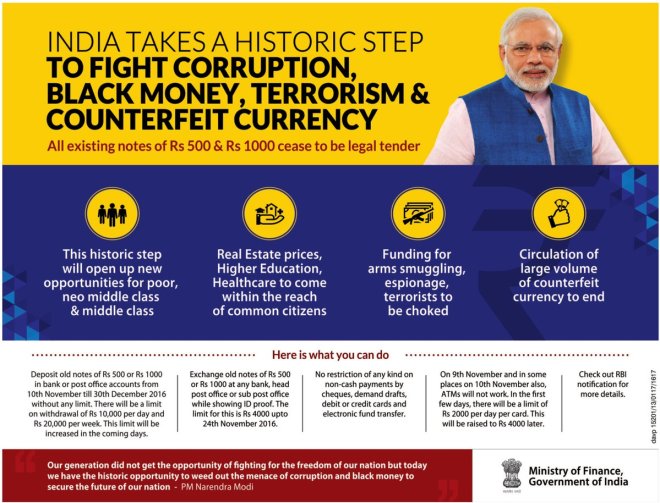
1000-notes-options

http://www.sbs.com.au/yourlanguage/hindi/en/article/2016/11/09/4-ways-non-residential-indians-nris-can-change-their-500-and-1000-rupee-notes

http://khaleejtimes.com/international/india/what-nris-in-uae-should-do-with-rs500-rs1000-notes

http://nricafe.com/5-ways-nris-can-convert-1000-500-rupee-notes/

http://economictimes.indiatimes.com/nri/nris-in-news/nris-in-uk-will-get-help-to-deposit-banned-notes-indian-envoy/articleshow/55356199.cms

There is some confusion whether NRIs/PIOs were allowed to carry INR 7500, 10,000, 25,000 or none at all while travelling into or out of India.

Rules have been changing and this link from RBI says NRIs/PIOS can bring into or take out from India only upto INR 5000. https://www.rbi.org.in/scripts/FAQView.aspx?Id=11

This Link from RBI says the amount of INRs NRIs and PIOs can take out of India or bring into India is upto INR 25000 per person. https://m.rbi.org.in/scripts/NotificationUser.aspx?Id=10268&Mode=0

Can Ministry of External Affairs, Finance Ministry, Reserve Bank of India and GOI authorities in Australia clarify this matter please?

It is likely that NRIs/PIOs will have small amounts (maximum of a few thousands) of INRs. Having said that, it is possible that the amount could be higher depending on number of people in the family. They do not wish to waste this money.

NRIs/PIOs have following options:

  1. Carry the cash if travelling to India until 30 December and deposit them in a Post Office or Bank. The option of changing them at the airport ended on 11 November.
  2. Exchanging of these notes at Exchange Houses or foreign branches of Indian Banks in our country of residence not available.
  3. Deposit these notes in your NRO (Non-Resident Ordinary) account if travelling until 31 March, 2017, but we need to be in India to do so. Foreign branches of Indian Banks in our country of residence are not doing it.
  4. Authorise someone including a relative to deposit these notes into your bank account if you have such notes in India. You will need to provide written authorisation and such authorised person will need to go to the Bank branch physically with all documents and identification. I presume you can get authorisation document with the help of your local Indian Embassy/High Commission/Consulate. This will need clarification from local GOI authorities.
  5. Send the money with someone you can trust or a family member who is travelling to India and get the money deposited in your account as explained in point (4).

Many of us might not have an NRO account.

As the acting High Commissioner of India in UK, Dinesh Patnaik, said, the best way might be to have the facility to open NRO accounts with the branches of Indian Banks operating overseas. (http://economictimes.indiatimes.com/nri/nris-in-news/nris-in-uk-will-get-help-to-deposit-banned-notes-indian-envoy/articleshow/55356199.cms). This is not available at present but he promised to work for it.

State Bank of India and a few more Banks have branches in Australia. This will be the case in many other countries too.

They should be able to allow us to open NRO accounts, if they get the permission by Government of India/RBI. This is feasible and is not a huge work.

it will ease the problem if NRIs/PIOs are treated as a special case and a consideration is given to extend the time by which they must deposit the notes in NRO accounts. It will help if they are given time until 31 December, 2017 to complete this process.

May we ask Indian High Commissioner in Australia and Consul Generals, as well as Ministry of Overseas Indians affairs, Ministry of External Affairs, Government of India, to take this matter up and help NRI/PIO community in Australia as well other countries with a practical mechanism in this matter?

Dr Yadu Singh

fianinc1@gmail.com

http://www.twitter.com/dryadusingh

http://www.facebook.com/dryadusingh

Committee’s Strategies for Indian Students’ Issues in Australia

No doubt, our students have several significant issues and these issues have been raised with Governmental and Police authorities here. We are very confident about serious actions in these matters. There is no choice here because the International education industry in Australia worth $16 Billion [about $2-3 Billion from Indian students] is at risk if prompt actions are not implemented.

As you may know, a community committee has been formed in consultation with Indian Consul General, Sydney to help tackle these issues. The committee members are Harry Walia, Vish Viswanathan, Stanley D’Cruz, Shubha Kumar and Yadu Singh [Coordinator].Following is a brief description of issues and proposed action plans by the committee.

These issues are;

1.                     Safety and Security:


Brief Details:

Several cases of robbery & bashings of Indian Students in Sydney.


Proposed Action Plan


  • Educate students to REPORT the incidents to NSW Police. Reporting does not affect their VISA.
  • Lobby with Councils for a better lighting around Railway stations, car parks and  alleys etc
  • Lobby with the local councils for the installation of CCTV for surveillance of crimes
  • Liaison with NSW Police re under-cover policing, more visibility and patrolling in hot-spots
  • Educate the students  to be street-smart and be aware of their  surroundings
  • Employers have a duty of care and must arrange them to be dropped off at their apartments if it is beyond 10 PM
  • Explore the issues involving “Work-cover” matters in case of injury/assaults


2.                     Accommodation for Indian Students


Brief Details:

No assistance on arrival. Many students forced to share crowded apartments and Poor treatment by rental agents


Proposed Action Plan


  • Lobby with authorities re the provision of 3-6 months accommodation which must be organised by education providers at the market cost


  • Lobby with Immigration regarding  this requirement [Visa must not be issued unless accommodation confirmed]


3.                     Quality of training:


Brief details:


Many students are exposed to poor quality of training by educational service providers & shady, shonky or bogus institutions.


Proposed action plan:


  • Accreditation authorities/bodies to audit the quality of training randomly and frequently
  • Lobby with respective Govt. Agencies to take proper actions on proved cases
  • Surveys from the present/past students re the quality issues [anonymously]
  • Effective and prompt action by DEEWR/ACPET re alternate placement in schools/institutions or refund of the tuition fees if the educational provider goes out of business


4.                     Exploitation of Indian students:


Brief details:


Indian students are exposed to exploitation of all kinds & bullying in part time employment or by educational service providers. They are getting below-award wages in many cases. Some Indian employers are also involved in this type of exploitation.


Proposed action plan:


  • To advise & educate students about their RIGHTS in Australia
  • To educate them re the appropriate agencies to deal with such matters
  • To encourage/facilitate genuine students’ associations which are largely run by students themselves, not business people with hidden agenda and purposes.


  • Indian community leaders to understand the “conflict of interests” concept when taking the leadership role in students’ matters. They must stay out from a leadership role if they are involved with any business involving students [schools or consultancy].   
  • To lobby for establishing an  overseas Students’ Ombudsman


5.                              Health Cover, other appropriate insurance matters and  emergency insurance:


Brief details:


Lack of proper/current Insurances and coverage by some students, particularly when they are on bridging Visa


Proposed Action plan:


  • Pre arrival Information package-in India
  • Lobby with government agencies re the need for the medical cover and emergency including death insurance.
  • Proper medical insurance including death insurance must be a condition for the Visa and such cover must be current at all times during the stay in Australia


6.                Social issues:


Brief details: poor communication, insufficient participation in local community events & meetings and poor public behaviour in many cases


Proposed action plan


  • Communication/education through community Radio, TV, newspapers and website.
  • Encourage participation of students in community events
  • Accept that we are the ambassadors of India
  • Know what is expected in every situation.
  • Encouraging and promoting “when in Rome, do as Romans do” policy for our students
  • www.indianstudents.net.au will be launched very soon with info on Australian rules/regulations, Australian ways, expected behaviour and rights/obligations [There is now sufficient information in these matters in High Commission of India, Canberra and Australian Gov websites]


7. Brief details: Indian students are unaware how to deal with emergency situations


Proposed action plan:


  • To provide information packages on service providers and counselling services
  • Look into possibility of a Community Helpline for non-emergency matters
  • Set up a website and link it to the Indian High Commission/CGI


8.   Develop the Indian media leadership group for students’ and community issues. This would give an opportunity to exchange views, form strategies and execute them effectively. India Media group will help in dissemination of the information. We recognise that we need a good relation with Indian and Australian media to be able to do an effective advocacy of Indian students’ issues with various Gov agencies and relevant stake-holders.


9.   To set up an INDIAN Students’ Emergency assistance and BENOVALENT FUND


10. To seek actively sincere and genuine community members and students for the continuation of the outlined tasks. Most times, Indian community members are aware about the exploiters from our own community. We must take it as our social/community responsibility to do a social boycott of such exploiters. We believe that exploitation of Indian students by Indian community members is the lowest of low and a despicable behaviour.


11.  To lobby for some transport concession.It is available all over Australia except NSW and Vic. It would encourage more use of public transport which might also reduce the assaults/robberies of students.


12.  To bridge the gap between Indian students and established Indian Australians by reaching out to Indian students, inviting them to social gatherings, mentoring them and providing help whenever practicable/possible.


Dr Yadu Singh

Co-ordinator

singhyadu@gmail.com


**PS: 29/8/09

[1]. The above mentioned committee had prepared its report and forwarded its recommendations to the relevant authorities.

[2]. After completing its job, the committee had dissolved itself at the end of June 2009 and communicated its decision to the Consul General on 1/7/09.

[3]. This report is being published with the purpose of making the community aware of its contents.