
——————————————————–
Clarification: Gautam Gupta, mentioned in this article, is an Audiologist, not a cardiologist.
Oz & us: A banged-up equation?
Dileep Padgaonkar, TNN, Apr 18, 2010, 01.39am IST
MELBOURNE: An evening of merrymaking that ended in a nightmarish experience in May last year gave Shravan Kumar his 15 minutes of fame. The young Andhraite, a student in a private college here, had hosted a party at his home in a western suburb of the city to celebrate his birthday. All the 20-odd guests were fellow Indians; all pursued vocational courses in institutions of dubious worth; all led a hand-to-mouth existence; all worked well beyond the stipulated 20 hours a week; all settled for wages much lower than the official wage; all lived four-to-six in a room; and all were fired by a single ambition: to acquire permanent resident (PR) status within two years of their arrival in Australia.
Liquor, much like loud music and laughter, flowed freely at the party. On such occasions, it is not unusual for uninvited guests to join in the revelry. When two young, white gatecrashers rang the doorbell, the Indians welcomed them with open arms. But soon the booze began to take its toll. Hot words were exchanged when the whites made passes at Indian girls. They were shown the door.
Minutes later the boys turned up again. Unknown to the Indians, one of them carried a screwdriver in the pocket of his trousers. They were allowed to come inside in the hope that they would behave themselves. But no sooner had they stepped in that the boy with the screwdriver plunged its sharp edge into Shravan Kumar’s skull. This is when all hell broke loose.
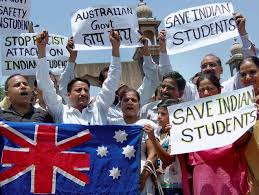
Even as Shravan Kumar struggled for his life in the hospital, a small group of left-wing radicals, both Indian and Australian, staged a demonstration outside the Victoria state Parliament House. They shouted angry slogans, pelted a few stones and bricks, broke some windows. From the sidelines, half a dozen or so members of the Australian Socialist Party, a fringe group, made provocative speeches. Among the rabble-rousers, according to a witness, was an Indian, Gautam Gupta, a failed businessman and a jobless cardiologist who over the years had fancied himself as an avatar of Mahatma Gandhi and Nelson Mandela. (Efforts to reach Gupta bore no fruit.) By sunset, the police had dispersed the demonstrators. Along the way however they, and especially the firebrand Gupta, attracted a huge amount of attention in the national media. And that coverage in turn got the Indian media all worked up.
On certain TV news channels in particular, charges of racism flew thick and fast. Fuelling their rage was the initial claim of the Australian authorities that race did not figure at all in the attacks. No one this writer spoke to, including office-bearers of the Federation of Indian Associations of Victoria, denied that racial prejudice had to be taken into account to understand the factors that led to the tragic sequence of events. At the same time they emphasized that such prejudice was limited to a small group of young ruffians. To focus solely on race, as the Indian media had done, detracted attention from the more important factors that caused the crisis in the first place.
The most significant factor by far was the decision taken by the previous John Howard government to open up the vocational education sector to private groups and link it with migration. This was the government’s logic: invite young people to study in the country in order to boost earnings from education; persuade them to develop vocational skills needed to grease the wheels of the economy; give them permission to do part-time work even while they took their courses; above all, dangle before them the carrot of PR status two years after their arrival, provided they acquired a certain number of points in their studies.
The policy was disastrous on many counts. Individuals with no experience in the educational field, including a shop assistant from Kerala, were allowed to open colleges. The government did not bother to find out how they functioned. There were no controls — on the kind of courses offered, fees charged, the number of students admitted. For instance, permission had been given to enrol, say, 250 students. Double the number were enrolled. In no time, more than 170 private colleges mushroomed in Victoria. As many as 40% of them were controlled by individuals from the sub-continent. More often than not, their backers were former Australian politicians. They constituted a powerful lobby that no government could go against.
Between 2006 and 2009, the annual number of Indian students admitted to private colleges was more than three times the 2005 figure. This was the handiwork of Indian agents — nearly 1,700 at the last count — whose job was to lure prospective applicants with tall promises. In return for an investment of Rs 12-15 lakh, the student was assured ‘help’ to procure a visa (including a certificate certifying good knowledge of English), admission to a ‘posh’ college, a well-paid job on arrival, good accommodation, a great lifestyle and, not least, PR status after two years. Most of the agents’ ‘victims’ came from three states — Andhra Pradesh, Gujarat and, above all, Punjab. The agent’s commission ran-ged between 15-20% of the overall expenditure.
Aiding, if not quite abetting, the agent was Australia’s lax visa regime. The visa-seeker had to furnish proof that he had enough money in the bank to pay for the travel, tuition fees and lodging and boarding costs for two years. With the agent’s help, a loan would be obtained from a bank by the applicant or his family, the money deposited in an account for three months and the bank statement attached to the visa application form. As soon as the visa was granted — without a counter-check or an interview — the loan was returned to the bank and the student was left high and dry.
This is where his travails began. There was no one to receive him at the airport. He had to make his own arrangements for accommodation. The ‘posh’ college was often a small, decrepit structure. Courses were few and far between. They were of course conducted in English, a language the student barely knew. To sustain himself, he worked long hours at all sorts of odd jobs and accepted wages well below the official rate, which placed him at odds with local job-seekers.
The illegal wage was paid in cash, which the student carried on his person. That made him a target for attack, especially when he took the last train home located in a remote suburb. In case he was assaulted, he never turned to the police for help because that would mean exposing the illegality of his working hours and wages. With no family support system, no contact with Indian associations or the Indian consulate, no friends in any other community, he had no choice but to seek the company of similarly placed fellow Indians. In the few hours he had for rest and leisure he would drink himself silly, sometimes take to drugs and gambling, enjoy loud music and, not least, chase girls. None of this obviously endeared him to the host population.
For Indian girls, the experience has proved to be far more harrowing. According to Krishna Arora, a community leader, Punjabi girls have been the worst victims of this search for an El Dorado. An educated girl is married off to a rich farmer’s son. In return, the father-in-law agrees to fund her travel, tuition and stay in Australia. Her husband, who is entitled to get a spouse visa, goes along with her. Once they land, the husband links up with other women, treats his wife shabbily and as soon as both get their PR, he files for divorce, obtains it and goes his own way leaving the young woman to fend for herself.
Last year, of the 18 cases of domestic violence reported to the Melbourne police, as many as 13 were student-related. Victims of such violence do receive some financial assistance from the government. But the money is grossly insufficient. As a consequence, more and more such women take to prostitution. Indian women make up a sizeable percentage of the escort service business in cities across Australia.
Indian community associations are making a valiant effort to come to the rescue of students duped into coming to the country. They are lobbying the government to strengthen security for Indians and to come down hard on the perpetrators of violence. The Indian consulate, too, is straining every nerve to assist them. But it is woefully understaffed. All the same, the leaders — including high-profile ones like Vasan Srinivasan, who very nearly got elected to the Victoria parliament; Vernon da Gama, a hugely sought-after solicitor and Ravi Bhatia, the suave and highly admired CEO of a telecom company — are unanimous in their belief that the issue at stake in the spate of attacks on Indians is not so much racism as a question of maintaining order and enforcing the law.
They repeat that the Indian media’s charges of racism quite correctly rile the Australians. This, in turn, tarnishes the entire Indian diaspora, most of whose members are successful professionals and adds strains and stresses to the India-Australia bilateral relationship. I asked the community leaders why Indians were targeted and not students from other countries. One reason, I was told, is that most of the other students come from good social backgrounds. They have a working knowledge of English and have the necessary funds to pay for their education.
Indeed, most of them study in universities, not in private colleges. Their numbers are small. As against this, the sheer size of the Indian student body, its general rowdiness, pecuniary situation and inability or unwillingness to live according to local norms gives it a higher visibility and makes it a target of suspicion, prejudice and sometimes violence.
Australia, one Indian executive told me, can be a tough place to live if you don’t know English, don’t know how to use a Western-style toilet, don’t know elementary rules of courtesy, if you don’t follow traffic rules and are perceived to be a lout. That, he said, was the case with most Indian students. And a bulk of them come from Punjab — indeed, straight from a Punjabi village to a cosmopolitan metropolis like Melbourne or Sydney. In no position to handle the culture shock, they just go out of control.
The attacks on Indians have, however, had a negative impact on Australia’s booming education business. Figures published by the Federal Education Department just days ago show an overall decline of foreign students seeking admission to the country’s colleges and universities. The decline is sharpest among Indian students. Numbers plummeted 40% in Victoria, from 6,303 to 3,761 for the first two months of the year. Especially affected are private vocational colleges. Experts believe that the numbers are likely to drop further in the months ahead.
The Australian authorities have finally begun to take meaningful steps to arrest the trend. Regulations for private colleges have been toughened; 21 rogue institutions have been identified. Rules have been changed to grant licenses to educational entrepreneurs. They are now obliged to re-register to meet the standards prescribed in the National Education Code. Some 1,500 educational providers have to undergo stringent tests. And courses like hair-dressing have been scrapped.
Visa regulations, too, have been revised. Now money needed for travel, tuition and boarding and lodging has to be deposited in a bank for six months instead of three. The Australian High Commission has been asked directly to consult chartered accountants and banks to verify the bonafides of the visa applicants. Living expenses have been raised from AU$1,000 to AU$1,500 a month. English proficiency tests have been made more rigorous. Most important of all, rules to grant permanent resident status have been overhauled to make it that much more difficult to immigrate.
Indian community leaders now hope that the Indian authorities will also crack down on unscrupulous agents and make sure that students wanting to study in Australia are given an accurate picture of the conditions that await them on arrival. Similarly, they would like on-the-spot reporting by Indian journalists of the problems confronting Indian students. This, they say, is urgent because under the revised rules, visas of a substantial number of students are not likely to be extended once they expire. This could well lead to more protests and perhaps to an outbreak of violence just in case a desperate student, unwilling to return to an uncertain future back home and fearful of losing face, attempts to commit suicide.
Meanwhile, Shravan Kumar has staged a remarkable recovery. The Australian government paid his hospital bills as he had no health insurance. It also funded the visit and stay of his father, brother and uncle. Undeterred by charges of racism and fears for his security, the young Andhraite applied for permanent resident status. He obtained it days ago. He is not quite sure if he will return to India once he finishes his courses. But chances are that he will choose to remain in Australia to get on with his life, hoping that by and by he will put behind him the birthday bash that turned into a ghoulish nightmare one balmy day in May last year.
Readers’ opinions (31)
Prerak Garg Kharagpur 18/04/2010 at 09:34 pm
A very nice and balanced point of view. Kudos to TOI for bringing out the true story.

Rohan Handa Melbourne, Australia 18/04/2010 at 08:31 pm
I am a student at Swinburne university, Melbourne and have been reading almost all the articles been written on this topic by various authors. This article, by far, is the most accurate and comprehensive account of whats really going on here. I would like to thank the author for his efforts.
reena India 18/04/2010 at 07:52 pm
It appears that you are one of the Indian journalists hired by the Australian government, whose entire living and travel expenses were paid, in order to project Australia’s image as a fair country, in the eyes of the International community! Are you one of those journalists, Mr. Dileep Padgaonkar??
Sunil Adelaide, Australia 18/04/2010 at 07:51 pm
Finally a well-researched honest article… If only every Indian was this sane….As an Indian living in Australia this is exactly how it was then, is now at present and will be in the future. A big clean-up act from both Indian and Australian authorities is the only way to right the wrong.
UMAKANT Melbourne 18/04/2010 at 07:10 pm
Good and TRUE article… it is a real scenario put in by this TOI article. I too agree with all things put in by Duleep. Most of the things happening against the Indian community is because of the raw and ripe behavior of their very own Country (PENDU or DESI) men.
 Yadu Singh's Blog