Article from Times of India newspaper reproduced fully.
The government has formed an inter-ministerial committee to look into concerns expressed by NRIs, tourists from abroad and foreign missions over demonetisation, the ministry of external affairs said on Thursday.
TNN | Updated: Nov 18, 2016, 03.02 AM IST
Highlights
Government has formed a panel to look into concerns of foreign tourists over demonetisation
Panel will look into concerns of NRIs holding Indian currency.
(A Russian tourist pose with a new Rs 2000 note in New Delhi. (AP photo)
NEW DELHI: The government has formed an inter-ministerial committee to look into concerns expressed by NRIs, tourists from abroad and foreign missions over demonetisation, the ministry of external affairs said on Thursday.
While foreign missions had sought MEA’s intervention to facilitate smooth collection of consular and visa fee and to allow them access to more funds, NRIs, money exchange associations, and foreign tourists abroad too have expressed concern about the difficulties being faced by them.
“The department of economic affairs has now formed an inter-ministerial committee headed at the level of an additional secretary. A senior joint secretary from the ministry of external affairs is also a member of that committee and we await their guidance, their advice and their recommendation which can then be shared with those various categories who have approached us,” said MEA spokesperson Vikas Swarup.
“Some (foreign missions here) have wanted to know if they could collect consular and visa fees in old notes. If so collected, they have sought to know how will those be exchanged,” said Swarup.
The second set of issues, he said, was related to NRIs having cash, or those holding Indian currency abroad. “If somebody has money abroad, and is not travelling to India immediately, what happens? How does he get new notes for those old notes?”
Top Comment
Yes Government is too slow. Giving heart attack to NRI. Still time to clarify stand as holidays are approaching.
dayaramDayaram Ramani
“The third set of issues is by the money changer associations abroad. This is quite interesting because we don’t have full convertibility…So, they have asked us the same question that what they would do with the stacks they have. How do they convert those?,” the spokesperson added.
According to the ministry, foreign visitors and tourists, particularly those coming for medical tourism, had asked MEA about some very specific requirements which needed to be looked into.
The Indian government likes to use the technical term “demonetisation” to describe the move, which makes it sound rather dull. It isn’t. This is the economic equivalent of “shock and awe”.
Image copyrightNARINDER NANU/AFP/Getty ImagesImage caption Long queues of people wanting to exchange the old notes have formed across India
Mr Modi’s “shock and awe” declaration meant that 1,000 and 500 rupee notes would no longer be valid.
These may be the largest denomination Indian notes but they are not high value by international standards – 1,000 rupees is only £12. But together the two notes represent 86% of the currency in circulation.
Think of that, at a stroke 86% of the cash in India now cannot be used.
What is more, India is overwhelmingly a cash economy, with 90% of all transactions taking place that way.
And that is the target of Mr Modi’s dramatic move. Because so much business is done in cash, very few people pay tax on the money they earn.
As a result huge numbers of Indians have stashes of tax-free cash hidden away – known here as “black money”.
Even the very poorest Indians have some cash savings – maybe just a few thousand rupees stored away for a daughter’s wedding, the kids’ school fees or – heaven forbid – an illness in the family.
Image copyrightDennis Brack-Pool/Getty ImagesImage caption India’s Prime Minister Narendra Modi gave only four hours’ notice of the move
The size of this shadow economy is reckoned to be as much as 20% of India’s entire GDP.
Mr Modi’s demonetisation is designed to drive black money out of the shadows.
At the moment you can exchange up to 4,500 (£48) of the old rupees in cash for new 500 (£6) and 2,000 (£24) rupee notes.
There is no limit to the amount that can be deposited in bank accounts until the end of December, but the government has warned that the tax authorities will be investigating any deposits above 250,000 rupees (£2,962).
Breach that limit and you will be asked to prove that you have paid tax. If you cannot, you will be charged the full amount owed, plus a fine of 200% of the tax owed. For many people that could amount to be pretty much the full value of their hidden cash.
This is brave politics. Some of the hardest hit will be the small business people and traders who are Mr Modi’s core constituency. They voted for him because they believed he was the best bet to grow the economy and improve their lot. They will not be happy if he destroys their savings.
Image copyright PUNIT PARANJPE/AFP/Getty ImagesImage caption Businesses will no longer take 500 and 1,000 rupee notes
Mr Modi says he is simply delivering on his pre-election promise to tackle corruption and tax evasion.
And, so far at least, the policy seems to be popular, in spite of the long queues and the fact that much day-to-day business in India has ground to a juddering halt.
Most Indians resent the fact that many of the richest among them have used black money to evade paying their fair share of tax and are happy to suffer a few weeks of what Mr Modi called “temporary hardships” to see them face justice.
They also recognise the benefits of drawing more people into the income tax net.
India has very low rates of tax compared to many other countries. The tax-to-GDP ratio – how much tax is raised as a proportion of the output of the economy – was 17% in 2013.
The average across the economies of the Organisation for Economic Co-operation and Development – a club of mostly rich nations – was over 34%.
Demonetisation is part of a wider project to draw Indians into the formal economy and to get them to start paying the tax they owe.
Image copyrightSAM PANTHAKY/AFP/Getty ImagesImage caption There is no limit to the amount of old notes that people can deposit in bank accounts until the end of December
And reducing tax evasion can only be good for India. The more money it raises in tax, the more it has to spend on useful stuff like roads, hospitals and schools.
The more the country spends on public goods like that, the faster the Indian economy is likely to grow – or so the argument goes.
So the big question is: will it work?
Some economists have questioned the decision to introduce the 2,000 rupee note. They say if the policy is designed to force people into the banking system why issue a higher denomination note – presumably an even more convenient vehicle for black money transactions?
But the headlines about chaos and confusion are a bit misleading.
There have been virtually no reports of violence despite the huge disruption this policy has caused.
Image copyrightPUNIT PARANJPE/AFP/Getty ImagesImage caption The new 500 and 2,000 rupee notes are in short supply and banks regularly run out of them
The queues are orderly and the worst you hear are the irritated mutterings of those whose days have been wasted standing in line.
But Mr Modi needs to be careful. The new notes are in short supply and there are not enough smaller denomination notes to go around, so the banks regularly run out of cash.
That cannot go on for long without irritation turning to anger.
But some queuing may be excusable, because in one regard the policy has already been a complete success: it came as a surprise to the entire country.
Think what that means. The government managed to plan this audacious policy, printing billions of new notes without anyone letting slip what was happening.
Reportedly, even senior members of the cabinet were not told what was being planned, for fear that if word got out the entire policy would be undermined. The hoarders would have time to empty their mattresses and launder their stashes into gold or other assets.
Keeping a secret of this magnitude in India, a country that thrives on rumour and gossip, is nothing short of a triumph and surely a reasonable justification for a few hiccups along the way.
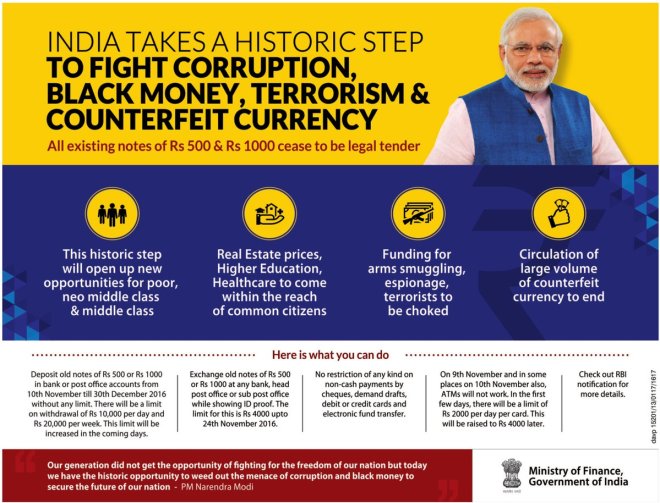
Indian Government demonetised (banned) INR 500 and INR 1000 notes on 8 November, 2016.
Indian Prime Minister, Narendra Modi, addressed the nation at 8 pm on Tuesday, 8 November and announced the banning of these notes from midnight. The justification for this decision was to control the menace of black money, which is a tool for tax avoidance and is often is also used to fund and spread terrorist activities in India. Apparently, millions of fake currency notes are smuggled into India from across the borders to finance terrorism in India. Political parties will be affected too because their (illegal) trenches of such notes will be worthless and will not be able to be used during elections.
Seemingly, it is a great decision which will be beneficial to Indian economy in the long term.
Black money is estimated to be 25% of India’s GDP and the commonest (estimated 80%) notes used for counterfeit currency are high denomination notes. If and when new notes of high denominations are printed and circulated by GOI, it is expected that they will have advanced security features which will make counterfeiting difficult, if not impossible.
This decision will therefore help India in many ways, although it will cause some temporary inconvenience to people. This could be due to short term restrictions on ATM usage, limits on maximum amount withdrawn from ATMs and banks and lack of sufficient supply of regular currency notes.
This decision affects NRIs and PIOs too. Many people travel to India at least once a year, and some do so even more often. It is not uncommon for them to have some Indian currency with them and bring it back to the country of their residence, while flying out of India. They carry it back with them when going back to India.
There are many in our community in Australia who have some Indian currency with them. Some may be travelling to India in November and December, but some may not be travelling to India for some time.
This issue are not confined to Indian Australians only. NRIs/PIOS all over the world are in the same boat.
It is not possible to exchange INR currency of high denomination into any other currency overseas presently and representatives of Indian Banks do not want to or are not authorised to deal with this matter presently.
Options which NRIs/PIOS can choose from are covered in the articles below.
Can Ministry of External Affairs, Finance Ministry, Reserve Bank of India and GOI authorities in Australia clarify this matter please?
It is likely that NRIs/PIOs will have small amounts (maximum of a few thousands) of INRs. Having said that, it is possible that the amount could be higher depending on number of people in the family. They do not wish to waste this money.
NRIs/PIOs have following options:
Carry the cash if travelling to India until 30 December and deposit them in a Post Office or Bank. The option of changing them at the airport ended on 11 November.
Exchanging of these notes at Exchange Houses or foreign branches of Indian Banks in our country of residence not available.
Deposit these notes in your NRO (Non-Resident Ordinary) account if travelling until 31 March, 2017, but we need to be in India to do so. Foreign branches of Indian Banks in our country of residence are not doing it.
Authorise someone including a relative to deposit these notes into your bank account if you have such notes in India. You will need to provide written authorisation and such authorised person will need to go to the Bank branch physically with all documents and identification. I presume you can get authorisation document with the help of your local Indian Embassy/High Commission/Consulate. This will need clarification from local GOI authorities.
Send the money with someone you can trust or a family member who is travelling to India and get the money deposited in your account as explained in point (4).
State Bank of India and a few more Banks have branches in Australia. This will be the case in many other countries too.
They should be able to allow us to open NRO accounts, if they get the permission by Government of India/RBI. This is feasible and is not a huge work.
it will ease the problem if NRIs/PIOs are treated as a special case and a consideration is given to extend the time by which they must deposit the notes in NRO accounts. It will help if they are given time until 31 December, 2017 to complete this process.
May we ask Indian High Commissioner in Australia and Consul Generals, as well as Ministry of Overseas Indians affairs, Ministry of External Affairs, Government of India, to take this matter up and help NRI/PIO community in Australia as well other countries with a practical mechanism in this matter?


 Yadu Singh's Blog
Top Comment
Yes Government is too slow. Giving heart attack to NRI. Still time to clarify stand as holidays are approaching.
dayaramDayaram Ramani